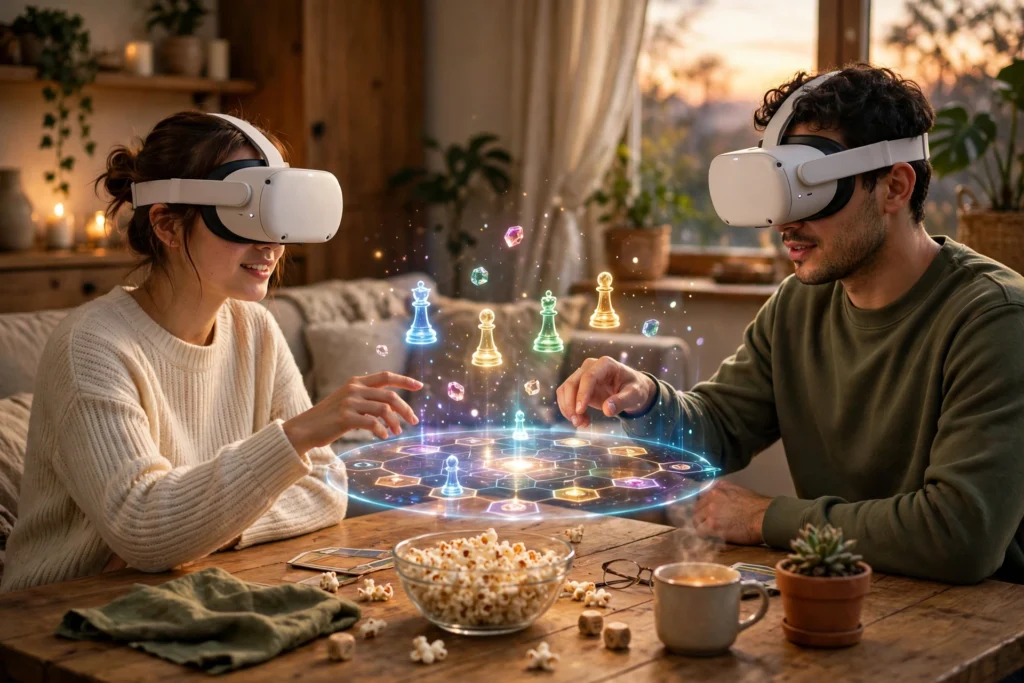
VR board games turn an ordinary game night into a shared virtual room: you put on a headset, sit around a digital table, and pick up cards, dice, and pieces with your hands, while friends join from their own living rooms as avatars.
Key Takeaways
- A VR board game is a board game rebuilt as software: the table, pieces, and rules all live inside the headset.
- You move pieces with hand-tracked gestures or controllers, and the game checks every move against its rules.
- Friends join as avatars from anywhere, so everyone needn’t be in the same room.
- The best setup is a clear play space, a charged headset, and a stable internet connection.
- Start with a simple game first — long sessions are the usual reason new players feel tired.
What does a VR board game actually look like?
Picture a normal table with a board on it. In virtual reality, that table is drawn by software, but everything else feels familiar: you see the board from above, lean in to read a card, and watch your friend’s avatar roll the dice. Some games copy a real board game almost exactly; others use the virtual setting for things a cardboard box never could, like a board that floats in space.
The big difference is that the computer does the fiddly work: it shuffles and deals, counts your points, and stops an illegal move before it happens. The game can also save your progress, so a long campaign can pause and pick up where you left it.
How do you pick up and move pieces in VR?
Many headsets track your hands with cameras, so you reach out, pinch a piece between thumb and finger, and place it where you want it — our guide to how VR hand tracking works explains the cameras behind that. Other games use handheld controllers: point, squeeze a trigger to grab, and release to drop. Controllers vibrate slightly when you pick something up, which helps your brain accept that the piece is really in your hand.
The headset tracks your head and hands many times a second, so the piece follows your movement smoothly — just keep your hands in front of you and in view of the cameras.
How do friends join a VR board game night?
Each player wears a headset and joins the same virtual room, usually by accepting an invite or entering a short room code. Inside, everyone appears as an avatar — a simple figure with a head and floating hands — and you hear each other through the headset, so it feels like sitting at the same table even when a player is in another country.
Most games also let someone join from a flat screen, which is handy if a friend doesn’t own a headset yet. They take their turn with a mouse or a gamepad, and everyone plays by the same rules either way.

What kinds of board games work best in VR?
Games mostly about talking, planning, and moving pieces tend to shine. Strategy games, word games, card games, and co-operative adventures all translate well, because the headset adds atmosphere without changing how the game is played — a dungeon crawler can put the dungeon on the table in front of you, and a word game can float the letters in the air.
Games that hide information still work: your cards are shown only to you. What doesn’t translate as well are dexterity games where you flick or stack real pieces — the headset can fake the physics, but not the weight of a real wooden block.
Do you need a special room or expensive gear?
Not really. A standalone headset — no wires, no separate computer — is enough for most VR board games, since they don’t demand the fast reactions of an action game. For background on the hardware, see Britannica’s virtual reality overview. What matters more is the space around you: a clear area with nothing fragile within arm’s reach, because you will reach out for pieces without looking at the real room. Our guide to how VR room mapping works explains how headsets draw a safe boundary for you.
Take the headset off for a short break every half hour during long sessions.
What should you check before your first VR board game?
Charge the headset fully, update the game before everyone arrives, and test the audio so you can hear your friends. Then do a quick practice round on your own: grab a few pieces, roll the dice, and try the buttons — five minutes of practice saves a lot of fumbling when the game starts.
Check the player count and cross-play support, so a friend on a different headset brand can still join. Look at the comfort settings too — most games let you reduce motion effects if you feel queasy. And agree on the house rules first: how long each turn gets, and what happens when someone’s battery runs out mid-game.

Can VR board games replace the real thing?
For some people, yes, and for others, not quite. VR is at its best when your friends live far away, when you want to try a game before buying the physical copy, or when you like a board that sets itself up. It keeps the social part of a game night — the jokes, the bluffing, the groans when someone rolls badly — while removing the travel and the tidying up.
What it can’t fully replace is the feel of a real table. Many players do both: VR for the weeknight game with faraway friends, and the cardboard box for the weekend when everyone is in the same room.
Frequently Asked Questions
Do all players need a VR headset to play a VR board game?
No. Most games let at least one person join from a phone, tablet, or computer screen — check the game’s description first, as the mix of VR and non-VR players varies from game to game.
Is VR bad for your eyes during a long board game?
Long sessions can leave your eyes dry or tired, as with any screen. Take the headset off every 20 to 30 minutes and look at something far away. If your eyes sting, stop for the night — the game will save your progress.
Can children play VR board games?
It depends on the headset maker’s age guidance and the game’s own rating, so check both first. Shorter sessions are sensible for younger players, and an adult should stay nearby for the first few games.
Do VR board games need an internet connection?
Yes, for multiplayer — you need a stable connection so everyone’s moves arrive in the right order. Some games have an offline solo mode, but a game night with friends needs the internet.
Conclusion
VR board games keep what makes board games worth playing — the people, the tension, and the small victories — in a virtual room your friends can join from anywhere. The board sets itself up and the rules are enforced for you. If you’re curious, pick a simple game, invite one friend, and see how it feels.