This article explains how surgical robots work in general terms. It is general information only, not medical advice. Decisions about any procedure should be discussed with a qualified clinician.
A surgical robot does not operate on its own. It is a set of precise tools that a trained surgeon controls in real time, usually from a console a few steps away from the patient. The surgeon moves hand controls and looks into a viewer, and the robot copies those movements through small instruments inside the body. The result is steadier, smaller-scale movement than a human hand can easily manage alone — but the surgeon stays in charge throughout.
In short, a surgical robot works by turning a surgeon’s hand movements into scaled-down, tremor-filtered movements of robotic arms, while a magnified 3D camera shows the operating area in detail. It is best understood as an extension of the surgeon’s hands and eyes, not a replacement for them.
Key Takeaways
- The surgeon controls the robot throughout; most systems do not make decisions or move on their own.
- Small incisions, a magnified 3D camera, and wrist-like instruments help with delicate work in tight spaces.
- Hand movements are scaled down and filtered, so a larger hand movement can become a tiny, steady instrument movement.
- A full team is still in the room, including staff at the patient’s side who change instruments and monitor safety.
- Cost, training, setup time, and suitability for each patient remain real limits, and robotic surgery is not the right choice for every procedure.
What exactly is a surgical robot?
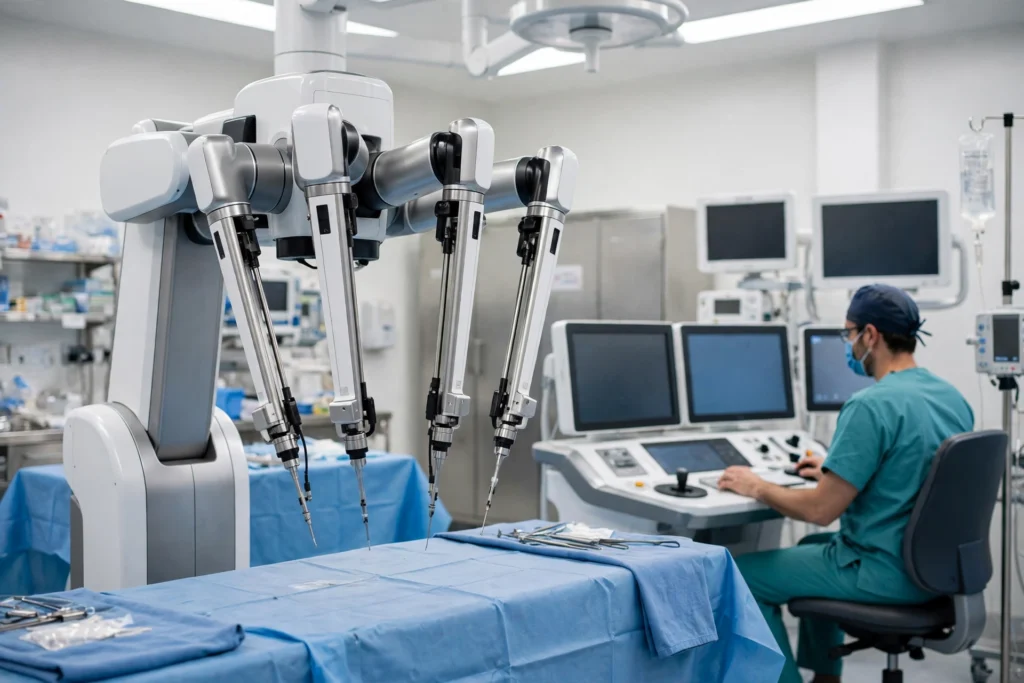
A surgical robot is usually a system with three main parts: a patient-side cart with robotic arms, a surgeon console, and a vision system. The cart sits beside the operating table. Its arms hold a camera and small instruments, which pass through narrow ports in the body. The surgeon sits at the console, looks into a viewer, and uses hand controls and foot pedals. Between them, a computer translates the surgeon’s movements into instrument movements.
That setup is closer to a factory robot arm than to a human-shaped robot. Like the arms described in our guide to robot arms, surgical arms are built around joints, motors, and careful control — only here the margins are millimetres, not centimetres.
How does the surgeon control the robot?
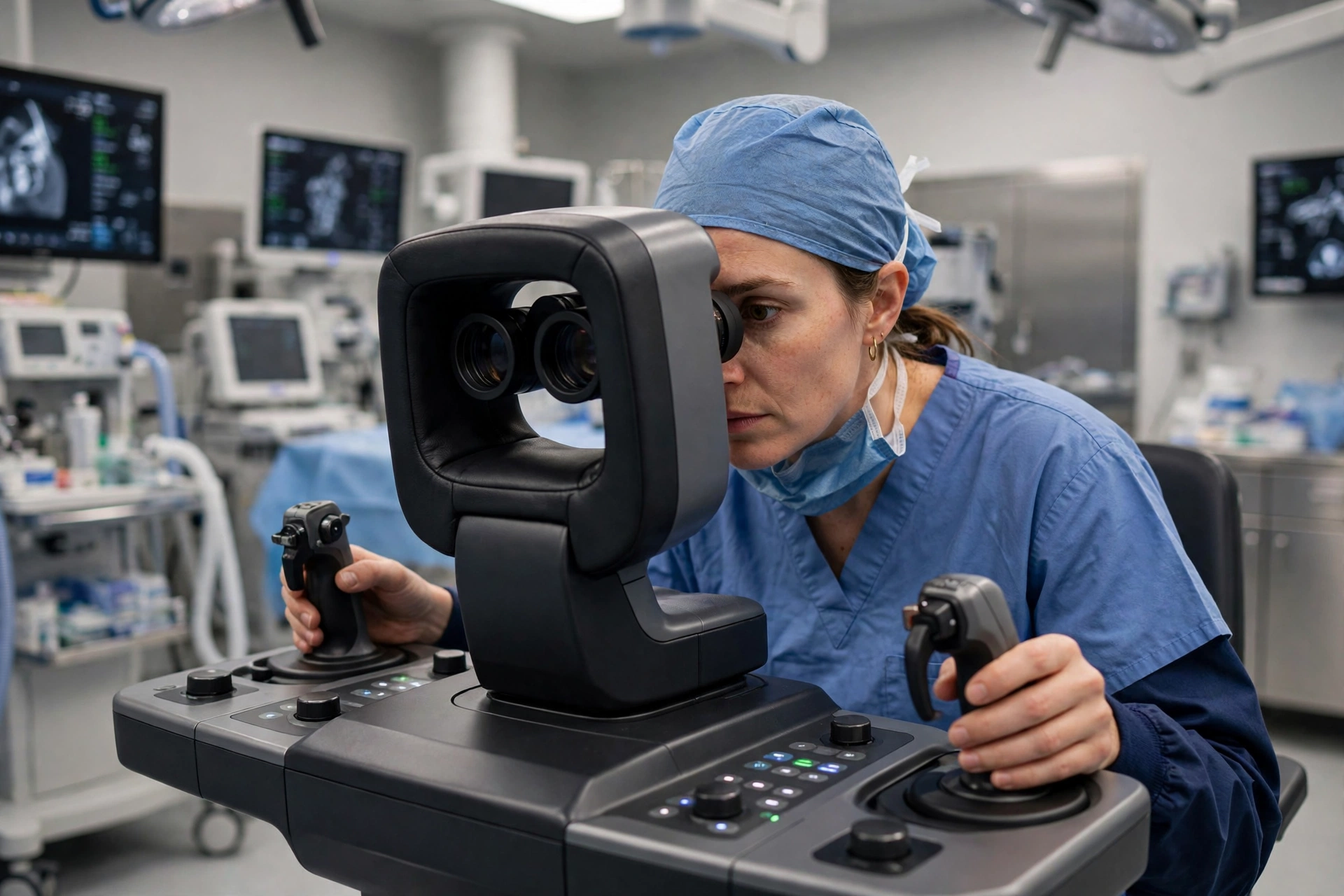
Control starts at the console. The surgeon rests their fingers in hand controls that track movement in several directions, much like holding a pair of small, sensitive handles. When the surgeon moves a handle, the robot arm copies that motion — often at a smaller scale. A movement of a few centimetres at the console might become a movement of a few millimetres inside the body. That scaling is one of the main advantages: it lets a surgeon work very precisely without needing impossibly steady hands.
The system also filters out small, natural hand tremor. Everyone’s hands shake slightly, even experienced surgeons. The robot’s software smooths those tiny shakes so they do not reach the instrument tip. It does not, however, decide where to cut or what to remove. In the systems used in most hospitals today, every instrument movement follows a surgeon’s movement. If the surgeon stops, the instruments stop too.
Foot pedals add another layer of control. They can switch between arms, control the camera, or activate an energy instrument used to cut or seal tissue. Some systems also let the surgeon clutch and reposition their hands, just as you might lift a computer mouse and set it down again to keep working comfortably.
What does the surgeon actually see?
Vision matters as much as movement. A camera arm carries an endoscope — a thin tube with a camera and light — into the body. The console viewer shows a magnified, three-dimensional view of the operating area, which helps the surgeon judge depth when working close to blood vessels, nerves, and other delicate structures.
That view is a step up from a flat screen in some important ways. Depth perception helps when grasping a tiny structure or placing a stitch. Magnification helps when the target is only a few millimetres across. The camera can also be moved and held steady by the robot, so the view does not drift the way a hand-held camera might. The rest of the team watches the same procedure on monitors in the room, which helps them follow what the surgeon is doing and prepare the next instrument.
Still, the view has limits. The surgeon cannot feel tissue directly through the robot in most systems — there is no true sense of touch, or haptic feedback, in the way a hand feels resistance. Surgeons compensate by reading visual cues closely: how tissue moves, stretches, or changes colour. That is a skill that takes training, and it is one reason robotic surgery is not simply a matter of sitting down at a new machine.
What are the instruments, and why are they so small?
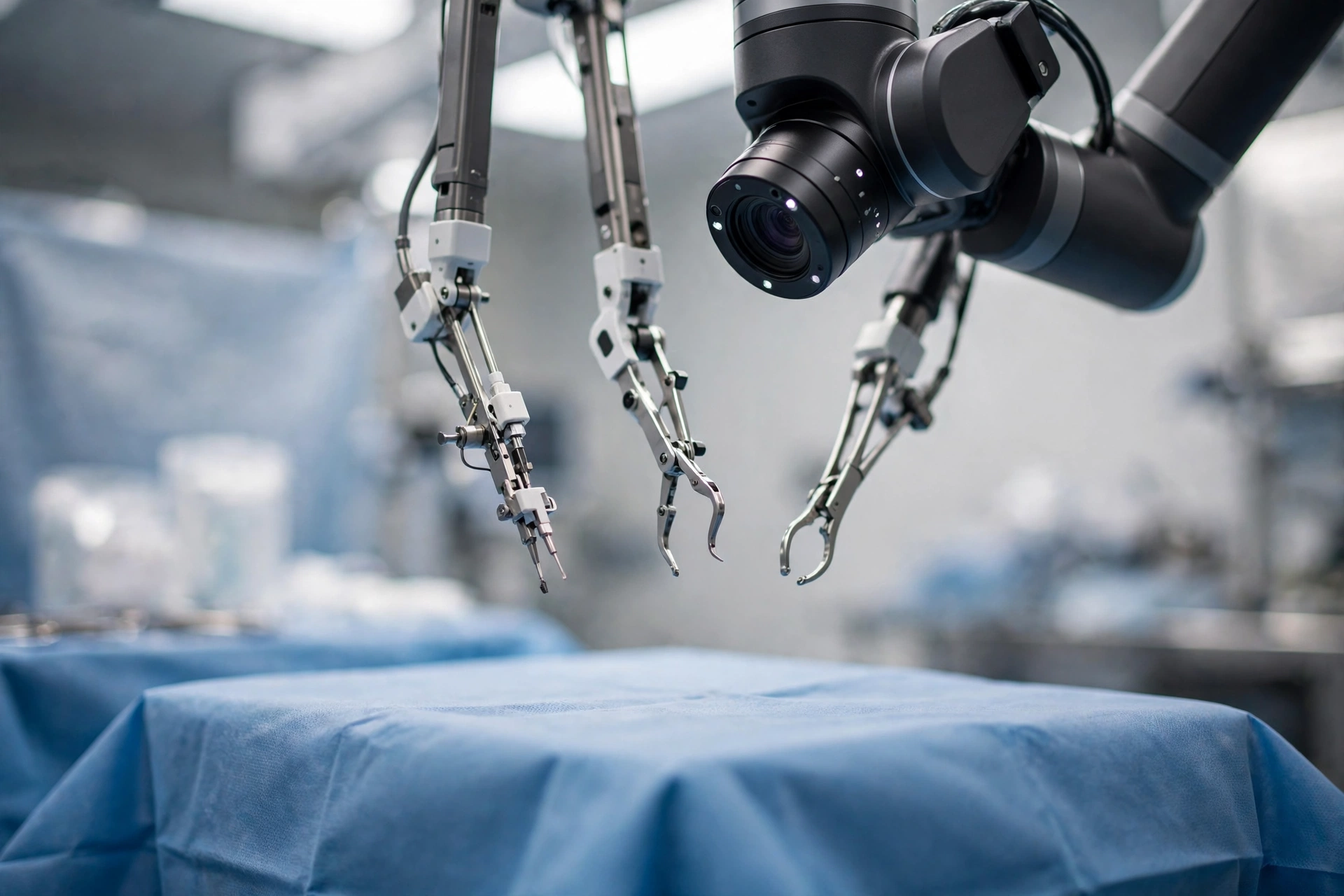
Surgical robot instruments are long, thin tools with wrist-like tips. The wrist can bend and rotate in ways a straight laparoscopic instrument cannot, which helps in tight spaces such as the pelvis or chest. Common tools include graspers, scissors, needle drivers for stitching, and instruments that can seal small blood vessels.
Because the instruments pass through small ports, the incisions can be smaller than those used in open surgery. Smaller incisions do not automatically mean a better outcome for every patient, but they are often linked with less disruption to surrounding tissue, and they are one reason robotic surgery is grouped with minimally invasive surgery. The trade-off is reach: the instruments work best within a defined area, and the team must position the patient and the robot carefully before starting so the arms can move freely without clashing.
What happens during a typical robotic procedure?
A robotic procedure still follows the familiar shape of an operation, with extra setup at the start. First, the patient is positioned and anaesthetised, and the surgical team prepares the operating area. Small incisions are made, ports are placed, and the robot cart is moved into position and docked — connected to those ports so its arms line up with the incisions.
Next, the surgeon moves to the console and begins the procedure, while an assistant stays at the patient’s side. That bedside role matters: the assistant changes instruments, helps with suction or retraction, and watches the patient and the robot arms. The surgeon and the team talk throughout, just as they would in any operation.
When the main part of the procedure is done, the instruments are withdrawn, the robot is undocked, and the incisions are closed in the usual way. Setup and docking add time, especially early in a team’s experience, which is why a robotic procedure is not always shorter than the alternatives. Over time, teams tend to get faster at the setup steps, but the careful positioning cannot be rushed.
What are surgical robots used for?
Surgical robots are used across a range of specialties, including urology, gynaecology, general surgery, and some chest and colorectal procedures. They are often chosen where fine dissection and stitching in a confined space are important — for example, work deep in the pelvis or around small structures where a wristed instrument helps.
They are not used for everything. Some operations need a wide, open view, rapid access, or instruments the robot does not carry. Emergency situations can also favour a more direct approach. Hospitals weigh the procedure, the surgeon’s experience, the equipment available, and the patient’s individual circumstances. A robot is a tool for certain jobs, not a default for all surgery.
Related robotic systems show the same pattern of specialisation. Robotic prosthetics, for example, translate a person’s signals into movement of an artificial limb, while telepresence robots carry a screen and camera so a clinician can be present remotely. Each system is built around one job, rather than one general-purpose robot doing everything.
What are the benefits and the limits?
The most commonly cited benefits are precision, a magnified 3D view, steadier movement, and smaller incisions than open surgery. For some patients and procedures, those features may support a smoother recovery, though outcomes depend on many factors — the condition being treated, the surgeon’s experience, and the patient’s overall health — not on the robot alone.
The limits deserve equal attention. Robotic systems are expensive to buy and maintain, and they take up room in an operating theatre. Surgeons and teams need dedicated training, and hospitals need enough suitable cases to keep skills sharp. If a complication arises, the team may need to convert to another approach, which is a planned possibility rather than a failure of the technology. There is also the question of access: not every hospital has a system, and not every patient will be offered robotic surgery even where one exists.
Safety features are built in, including limits on how far arms can move, checks before instruments are activated, and the ability to pause. But no safety feature removes the need for judgement. The surgeon decides what to do, the team checks each step, and the robot executes only what it is told to do.
Frequently Asked Questions
Does the robot operate by itself?
No — in the systems used in most hospitals, the surgeon controls every movement from the console. The robot does not decide what to cut or remove on its own.
Is robotic surgery the same as keyhole surgery?
They overlap but are not identical. Both use small incisions and a camera, but robotic surgery adds a console, wristed instruments, and a magnified 3D view, while traditional keyhole surgery uses hand-held instruments.
Does a smaller incision always mean a faster recovery?
Not necessarily. Recovery depends on the procedure, the patient’s health, and what happens during and after the operation. Smaller incisions can help, but they are only one part of the picture.
Why isn’t robotic surgery used for every operation?
Some procedures need a different approach, the equipment may not suit the anatomy, or the hospital may not have a system. The choice is made case by case, based on the procedure and the patient.
What should a patient ask before robotic surgery?
Useful questions include why this approach is being suggested, what the alternatives are, how experienced the team is with this procedure, and what recovery and follow-up usually look like. This article is general information only and is not a substitute for advice from the treating clinician.
Conclusion
Surgical robots work by giving a surgeon steadier hands, a closer view, and wrist-like instruments that can work through small incisions — while leaving every decision and every movement under human control. The console, the arms, and the camera are impressive, but the real system is larger: surgeon, bedside team, patient, and machine working together, with safety checks at each step.
If you want to understand the field further, a practical next step is to compare a robotic procedure with its non-robotic alternative for the same condition, and to notice where the robot genuinely helps — precision in a tight space, a steadier view — and where it does not change the fundamentals of surgery. That comparison is more useful than any claim about a machine on its own, because in surgery, as elsewhere in robotics, the tool matters less than the judgement of the person using it.
For background, see Britannica’s robotics overview and Wikipedia’s guide to robot-assisted surgery.