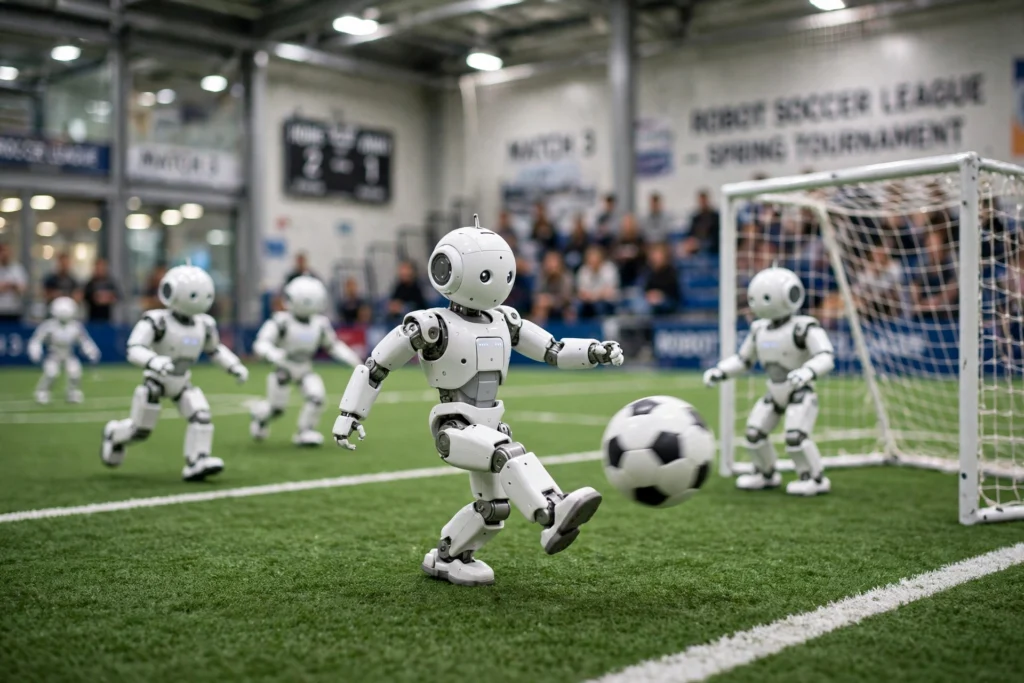
Yes. Robot soccer is real, and the players are fully on their own once the whistle blows. Nobody steers them with a remote control. Each robot watches the pitch, works out where the ball and the goals are, and decides whether to chase, pass, shoot, or defend. The sport’s long-term goal is a robot team beating the human World Cup winners.
Key Takeaways
- Robot soccer players are fully autonomous during a match: no remote control, no outside computer helping them.
- Each robot sees the game through cameras in its head and works out where it is from the lines on the pitch.
- Walking on two legs, kicking, and getting back up after a fall are the hardest parts.
- RoboCup aims for a robot team to beat the human World Cup winners by the middle of this century.
- The same skills — seeing, deciding, and moving in a changing world — are what service and rescue robots need too.
What is robot soccer, exactly?
Robot soccer is a sport played by machines, and a research project at the same time. The main competition is RoboCup, an international tournament founded in 1997. Teams play football under rules adapted from FIFA’s laws, on smaller pitches, with simpler versions of rules like offside dropped. The humanoid league is the best known: players must have a human-like body — a trunk, two legs, two arms, and a head — and may only move by walking on two legs. There are wheeled leagues too, but the humanoid league draws the crowds: watching a knee-high robot wobble toward the ball, swing its leg, and topple over is both funny and impressive.
How does a robot soccer player see the game?
A humanoid player sees the world through one or two small cameras in its head. They pick out the ball, the field lines, the goals, and the other players, mostly by colour: the ball is usually black and white, the goals are yellow and blue, and the pitch is green with white markings. From those colours and shapes, the robot’s onboard computer builds a picture of where everything is.
The tricky part is that the robot is always moving. Its head bobs as it walks, so the picture shakes. The robot combines what its cameras see with what its balance sensors feel, so it can tell the difference between the ball moving and its own head moving. It also works out where it is on the pitch — a skill called self-localisation — by matching the lines and goal posts it sees against a map of the field in its memory.
How do robot soccer players decide what to do?
Every robot runs a layered set of behaviours, a bit like a footballer’s instincts stacked on top of each other. At the bottom are the basics: keep your balance, walk straight, turn without falling. Above those sit the skills: walk up to the ball, line up a kick, get back up after a fall. At the top sit the team behaviours: chase the ball, pass to a teammate, drop back to defend.
The robots also talk to each other over a wireless network, sharing what each one can see. Roles are negotiated on the fly: the robot nearest the ball becomes the attacker, and the others spread out. Nobody on the sideline tells them what to do — the referee’s signals arrive through the official GameController, and every robot obeys them. It is the same work that robots avoiding obstacles do in warehouses and homes: sense the world, choose an action, and act before the moment passes.
How do they kick, walk, and get back up?
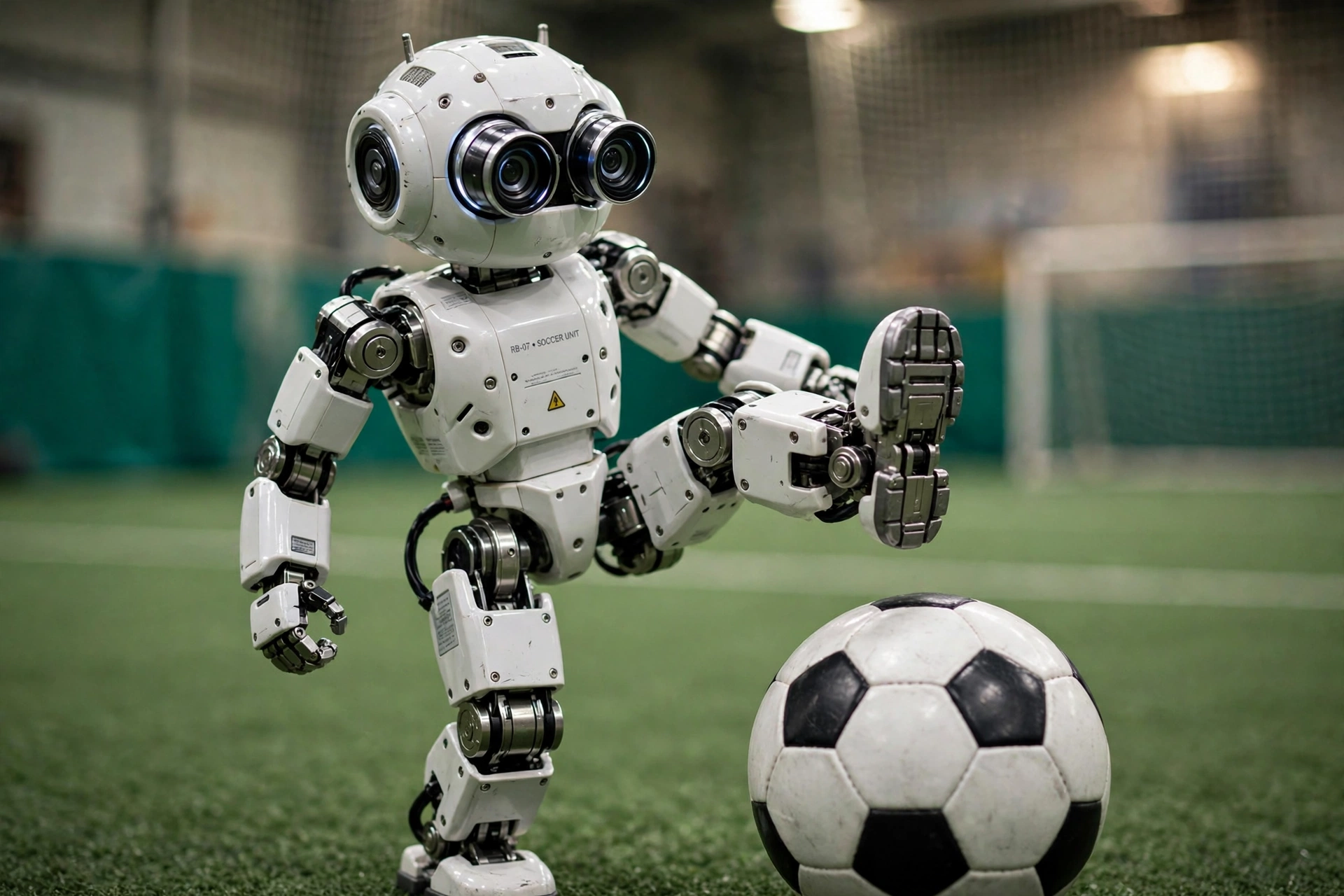
Walking on two legs is the hardest skill in robot soccer. A humanoid robot has twenty or more joints, and each step is a controlled fall: lean forward, swing a leg, catch yourself, repeat. A nudge from an opponent or a badly timed kick can send it over. The robots that win are often not the fastest — they are the ones that fall least and recover quickest.
Kicking is a whole-body movement: plant one foot, swing the other, follow through, keep your balance. When a robot falls, it has a rehearsed routine — roll, push up with its arms, stand again. A robot down for ten seconds is a player missing from the game, so getting up fast is practised as seriously as shooting. The same joints and motors that power robot arms drive a soccer robot’s legs, and the same balance sensors keep humanoid robots upright on a pitch or in a home.
Which league plays which way?
| League | Players | How they move | What makes it hard |
|---|---|---|---|
| Humanoid League | Human-like robots, up to 1.25 m tall | Walk on two legs | Balance and getting up |
| Small Size League | Wheeled robots, shoebox-sized | Wheels, very fast | Split-second teamwork |
| Middle Size League | Larger wheeled robots | Wheels with onboard cameras | Seeing without an overhead camera |
The humanoid league is the slowest and the most human to watch. The wheeled leagues are faster and more precise, closer to high-speed chess. All three count toward the same goal.
Who plays robot soccer today?
RoboCup runs every year, with university teams and independent clubs from dozens of countries. The 2050 goal — a robot team beating the most recent World Cup winners under FIFA rules — sounds like science fiction, but the tournament has moved steadily toward it: from walking around a pole, to penalty kicks, to full five-a-side matches.
New teams keep joining. FOOMBOT, an independent team from Warsaw, was formed in 2026 and finished third at its first official tournament, the RoboCup Italian Open at Maker Faire Rome in October 2026. Its ten Booster K1 humanoid robots — about 95 cm tall, with 22 joints and a stereo camera in the head — find the ball, decide whether to pass or shoot, and get back up after a fall, all without anyone steering them. That loop — try, watch, fix — is how robotics as a field advances, and football is a remarkably good test: it needs vision, balance, teamwork, and fast decisions, all at once.
What are the limits?
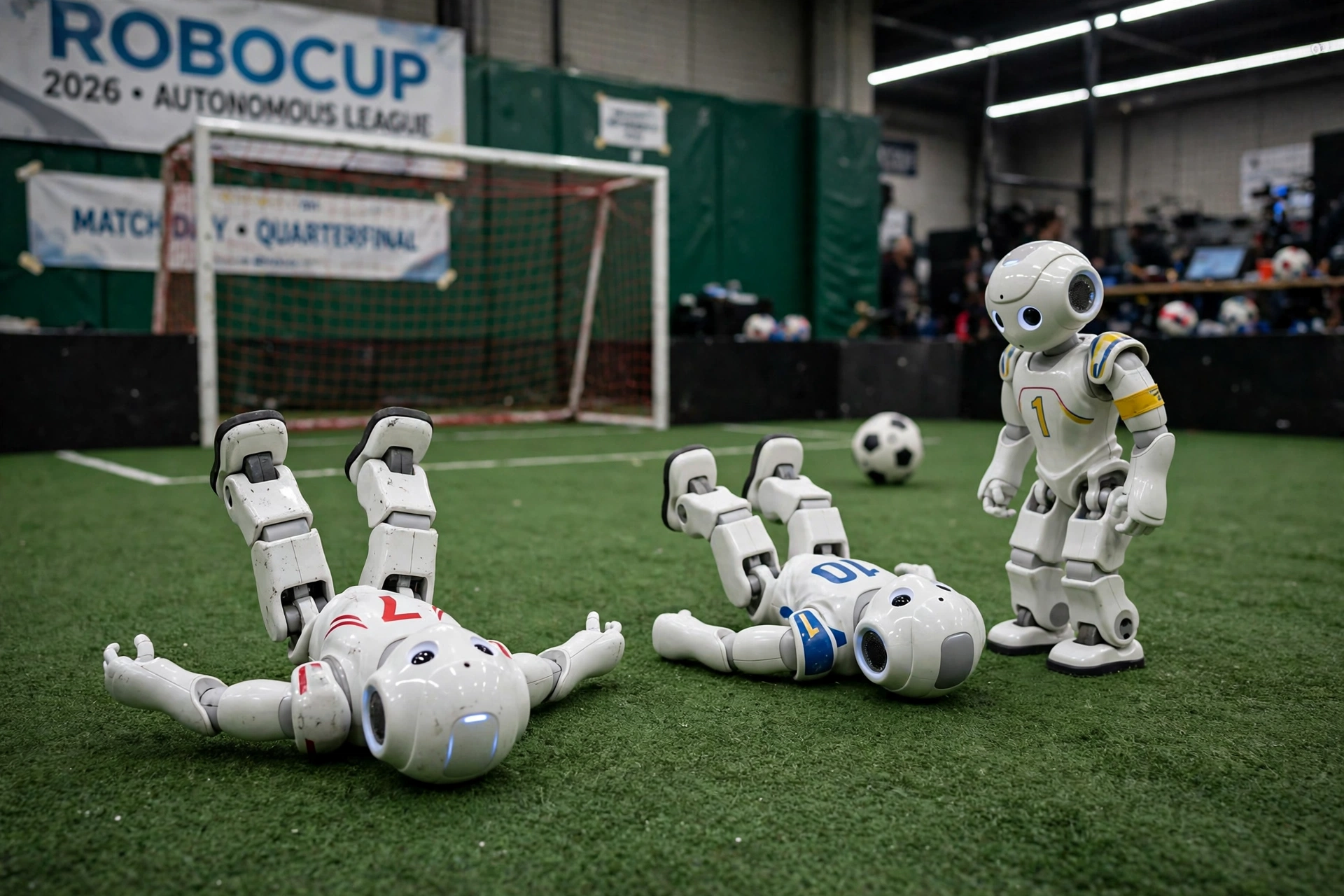
The honest limit is that robot players are still far slower and clumsier than people. A humanoid robot walks at a careful shuffle, its kicks are gentle, and a wet or uneven pitch can stop a match entirely. The ball is smaller and lighter than a real football, the goals are smaller, and some rules are simplified so the game can happen at all.
There are practical limits too. The robots are expensive, their batteries last about an hour of play, and a hard fall can break a joint or a camera. And the 2050 goal is deliberately ambitious: beating the World Cup winners means matching human speed, strength, and judgement, not just playing tidy five-a-side on a small pitch. But robot soccer is a shared benchmark: a hard, public test where every failure is visible, and the skills learned here carry into factories, hospitals, and homes.
FAQs
Could a robot soccer team beat a human team today?
Not a chance. A good human team would score at will against robots that walk at a shuffle and kick gently. RoboCup’s goal is set for the middle of this century, and the gap is still enormous.
How big are humanoid robot soccer players?
It depends on the division. KidSize robots are up to 60 cm tall, TeenSize robots are 80 to 160 cm, and the Middle division allows robots up to 1.25 m tall and 25 kg. Most are well under a metre.
Who controls the robots during a match?
Nobody. The robots are fully autonomous once play starts. A referee sends game states like kick-off and stop through the official GameController, and people only step in when the rules allow it, for example to pick up a robot that cannot get up on its own.
What happens when a robot falls over?
It runs a get-up routine: roll, push up with its arms, and stand. The best teams practise this until it takes a couple of seconds. A robot that cannot get up is removed from the field until it can be reset.
Is robot soccer only for universities?
Mostly, but not only. University labs dominate RoboCup, yet independent teams like FOOMBOT show that a group of enthusiasts with standard robot platforms can enter the competition and do well.
Conclusion
Robot soccer players are small, slow, and gloriously clumsy — and they are also one of the hardest problems in robotics, solved in public, one match at a time. They see the game through their own cameras, decide for themselves when to pass or shoot, and pick themselves up when they fall. The 2050 goal of beating the World Cup winners is still a long way off, but every tournament moves the robots a little closer, and the skills they learn on the pitch are the same ones robots need everywhere else.
If the idea grabs you, watch a match: full games are posted online by the tournament and by the teams, and a single five-a-side match shows you more about what robots can and cannot do than a shelf of articles. Look for the falls — that is where the engineering lives.
Further reading: RoboCup — the official site · RoboCup on Wikipedia