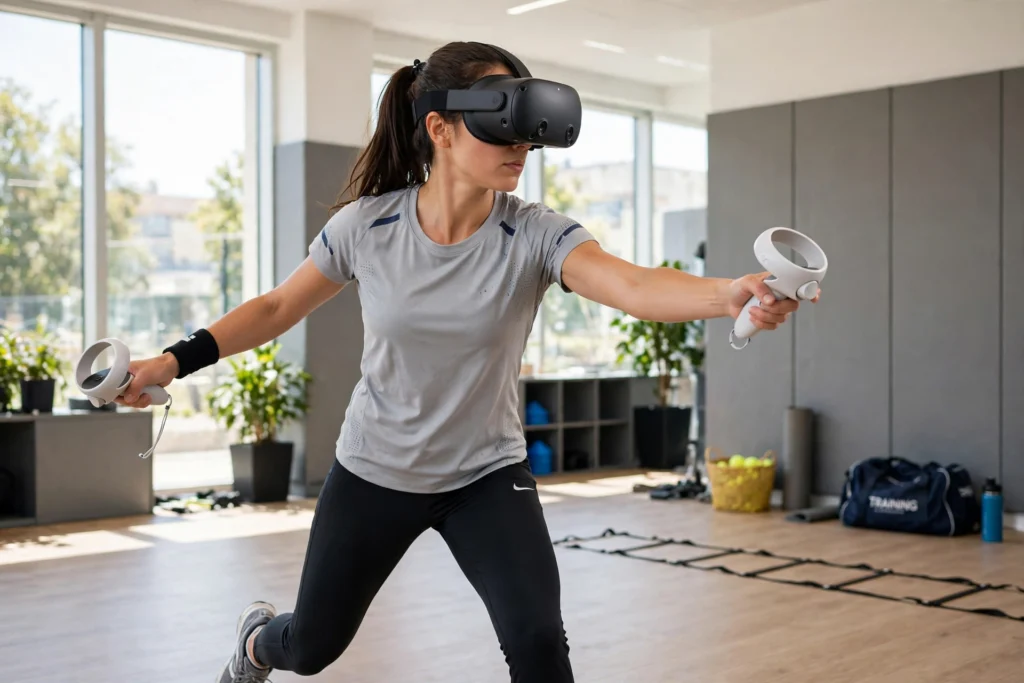
VR sports training works by putting an athlete inside a realistic virtual practice scene, where they can repeat a skill, face a game situation, or review a decision again and again without needing a full team, a pitch, or perfect weather. The headset tracks their head and hands, shows a virtual court, pitch, or ring, and lets them react to virtual opponents, balls, and plays in real time.
Key Takeaways
- VR sports training is best for repetition, reaction time, and decision-making, not for replacing strength, fitness, or real contact practice.
- The headset tracks head and hand movement, while software creates opponents, balls, and game situations that respond to the athlete.
- Coaches can replay a drill, slow it down, and point out positioning or timing that is hard to see in a fast live game.
- VR works best in a clear, safe space with a guardian boundary, and sessions should stay short, especially for beginners.
- Results vary by sport and by app, so treat VR as a useful extra training tool, not as a guarantee of better match performance.
What is VR sports training?
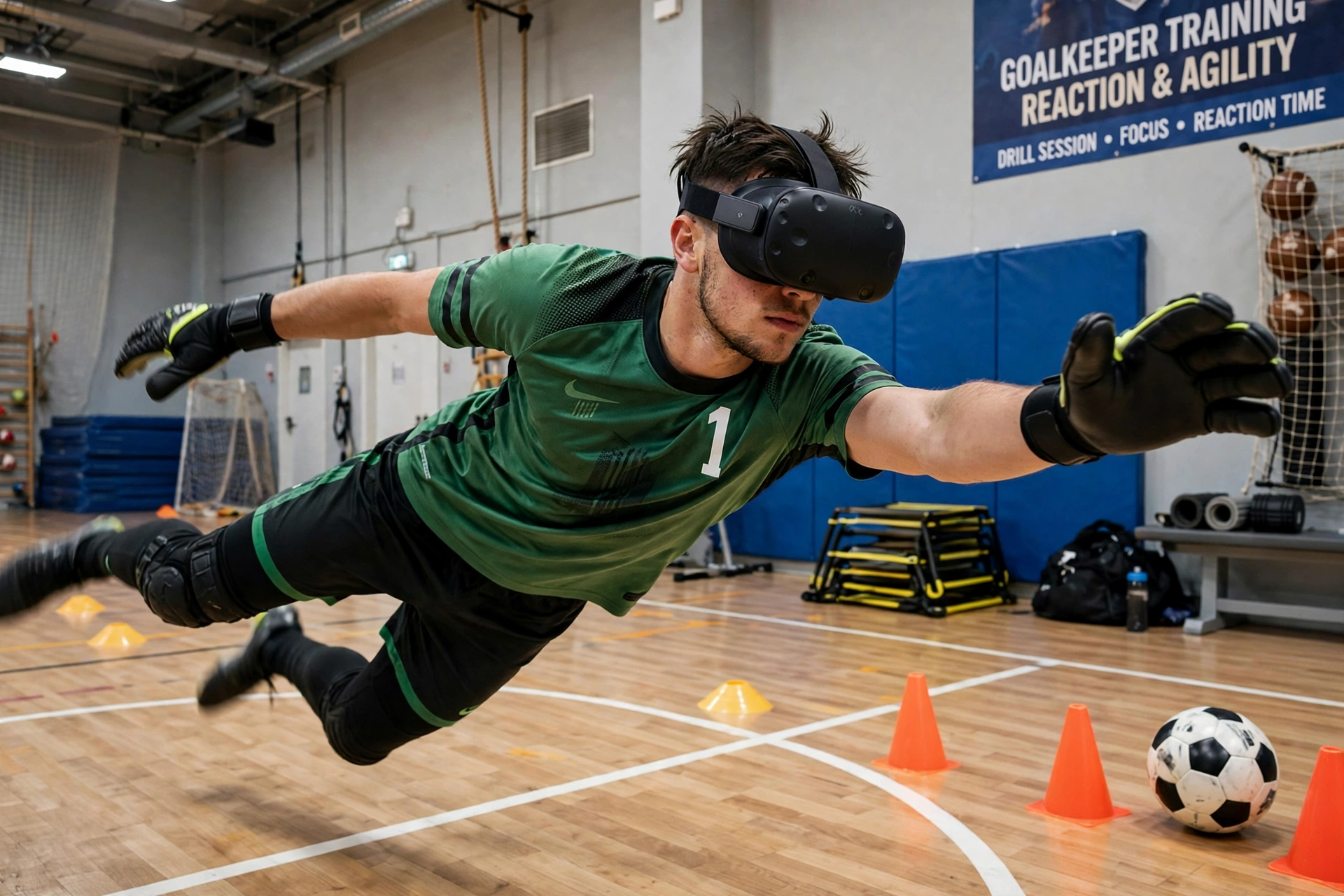
Think of VR sports training as a practice room you can carry with you. Instead of waiting for a training partner or a booked facility, an athlete puts on a headset and steps into a virtual version of their sport. A tennis player might face serves from a virtual opponent. A goalkeeper might watch virtual shots coming from different angles. A boxer might work on slipping and blocking without taking a real hit.
The point is not to make the virtual world identical to the real one. It is to isolate one skill at a time and repeat it far more often than a normal session allows. In a live game, a goalkeeper might face only a handful of shots in an hour. In VR, they can face dozens of similar shots in a few minutes, with the speed, angle, and timing changed slightly each time. That repetition is where VR earns its place.
It also helps with the mental side of sport. Many mistakes in games are not about fitness or strength, but about looking in the wrong place, reacting a fraction late, or choosing the wrong option under pressure. VR can recreate those moments — a fast break, a penalty, a serve at match point — and let an athlete practise the decision, not just the movement.
How does a VR sports session actually work?
A typical session starts with the basics: clear the space, set the guardian boundary, and put the headset on. The headset’s outward cameras track the room, while its sensors track head movement and, in many cases, hand movement through controllers or hand tracking. That is the same foundation described in our guide to how VR headsets work, applied here to a training hall instead of a game world.
Once inside the app, the athlete chooses a drill. The software then places them in a virtual scene — a court, a pitch, a gym, or a stadium — and presents a task. It might be to return a serve, block a shot, dodge an incoming object, or choose the best pass from several options. As the athlete moves, the headset updates the scene, so turning the head changes the view and moving a hand moves a virtual racket, glove, or bat.
After each repetition, many apps give simple feedback: reaction time, accuracy, or whether the chosen option matched the coach’s plan. That feedback loop matters. Without it, VR is just a game. With it, an athlete can spot a pattern — for example, always reacting late to shots on one side — and work on that specific weakness in the next set of repetitions.
What skills does VR train best?
VR is strongest where repetition and quick decisions matter. Reaction training is an obvious example. A goalkeeper, a batter, or a table tennis player needs to read a movement early and respond in a fraction of a second. VR can present those cues again and again, with small variations, so the athlete learns to pick up the earliest useful signal — a shoulder turn, a racket angle, a run-up — rather than waiting for the ball itself.
Decision-making is another strong area. Team sports are full of choices made under time pressure: pass or shoot, press or hold position, go left or right. In VR, a coach can freeze a moment, show the athlete what was open, and then replay a similar situation with a different layout. That kind of deliberate practice is hard to arrange in a live scrimmage, where the next play is already happening.
Technique can benefit too, but with a caveat. VR can help an athlete practise footwork patterns, head position, and timing in a controlled way, and it can record movement for later review. It cannot, however, fully recreate the weight of a real racket, the resistance of a real opponent, or the feel of a real ball. That is why coaches usually pair VR drills with real practice, using VR to build the pattern and real sessions to test it under full physical conditions.
What about fitness, strength, and contact?
This is where expectations need to stay realistic. VR can raise your heart rate, especially in fast, full-body drills, and some fitness apps are designed around that. But it is not a replacement for strength training, conditioning, or the specific fitness a sport demands. A virtual sprint does not load your legs the way a real sprint does, and a virtual tackle does not prepare your body for real contact.
Contact sports need particular care. VR can help with positioning, timing, and decision-making before contact, but it cannot safely teach tackling, blocking, or falling in the way real, supervised practice can. Coaches who use VR well tend to be clear about this boundary: VR for the read and the reaction, real practice — with proper coaching and safety measures — for the physical contact itself.
The same applies to injury recovery. VR can be useful for gentle, controlled movement and for rebuilding confidence after time away, but only as part of a plan agreed with a coach or health professional. It should not be used to rush back into full training, and any pain, dizziness, or discomfort during a session is a reason to stop, not to push through.
How do coaches use VR training data?
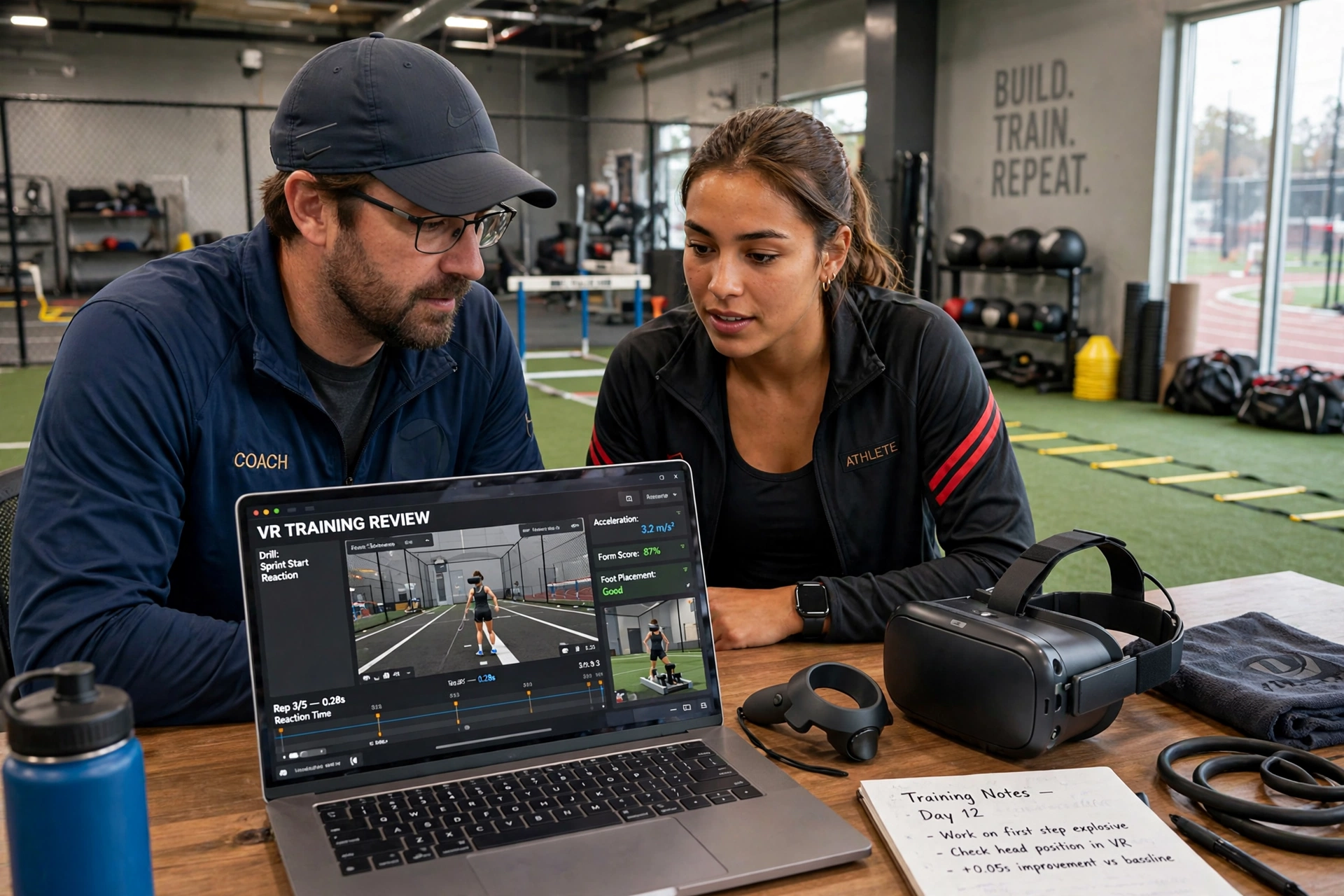
One of the quieter benefits of VR is the record it leaves behind. A coach can watch a replay from the athlete’s point of view, see exactly where they were looking, and compare one repetition with the next. That is much harder in a live game, where the coach sees the play from the sideline and the athlete remembers it from inside the action.
In practice, this often looks like a short review after a set of drills. The coach and athlete sit down, watch a few key moments, and talk about positioning, timing, or choice of option. The athlete then goes back into VR and tries the same drill with one clear change in mind — earlier movement, wider stance, quicker first step — rather than a vague instruction to “do better.”
It is worth keeping this data in proportion. A reaction time in VR is not the same as a reaction time on a real pitch, because the headset, the virtual scene, and the lack of real physical feedback all change the task. Coaches who use VR well treat its numbers as a guide for training, not as a ranking of who is the best athlete. The real test is still what happens in a match, on a court, or in a ring.
How do you train safely in VR?
Safety starts before the headset goes on. Clear the space of furniture, cables, and anything you could trip over, and set the guardian boundary honestly — not wider than the space you actually have. If you are doing fast, full-body drills, a larger clear area is better, and a spotter or coach nearby is sensible, especially for beginners or for drills that involve diving, lunging, or turning quickly.
Keep sessions short at first. Many people find VR tiring in a different way from normal training, because the eyes and the balance system are working hard to make sense of a virtual world. Start with ten to fifteen minutes, take a break, and build up gradually. Drink water, stop if you feel dizzy, nauseous, or get a headache, and do not try to train through VR sickness — it usually gets worse, not better, if you push on.
Footwear and floor matter too. Wear the shoes you would normally train in, if the app involves footwork, and avoid slippery socks on a smooth floor for drills that need quick stops. And remember that VR hides the real room: if someone walks into your space, a pet runs in, or a child enters the area, you may not see them. Training in a closed, supervised space avoids most of these surprises.
If you are new to headsets, our guide to how VR room mapping works explains how the guardian boundary is built, and our guide to how VR controllers work covers how hand input is tracked during drills. Both are worth a quick read before your first fast-moving session.
Which sports suit VR training?
VR fits some sports more naturally than others. Sports with clear, repeatable moments — a serve, a penalty, a pitch, a putt — translate well, because those moments can be recreated and varied in software. Team sports with fast decisions, like football, basketball, and hockey, can use VR for reading the game and choosing options, even if the full physical game still needs a real pitch or court.
Individual and precision sports can benefit too. Golfers can practise reading a green, archers can work on focus and routine, and martial artists can drill timing and distance without full contact. In each case, the value comes from repeating the mental and timing parts of the skill, not from pretending the virtual version is the same as the real one.
Sports that depend heavily on feel — the weight of a ball, the grip of a racket, the resistance of water — are harder to recreate fully. Swimmers, rowers, and weightlifters, for example, will get less from a headset than from their normal training environment. That does not make VR useless for them, but it does mean it should sit further down the training plan, perhaps for visualisation, tactics, or recovery sessions, rather than at its centre.
Frequently Asked Questions
Can VR sports training replace real practice?
No. VR is best as a supplement to real practice, not a replacement for it. It is excellent for repetition, reaction, and decision-making, but it cannot fully recreate strength, fitness, real contact, or the feel of equipment. Most coaches use it alongside normal training, not instead of it.
Do you need a large room for VR sports training?
It depends on the drill. Seated or standing drills need very little space, while full-body drills with lunging, diving, or turning need a larger clear area and a properly set guardian boundary. Always set the boundary to the space you actually have, and use a spotter for fast drills.
Is VR sports training safe for children?
It can be, with supervision, short sessions, and age-appropriate apps, but headset makers set minimum age guidance for a reason. Children should train in a clear, supervised space, take frequent breaks, and stop if they feel dizzy or unwell. Check the headset’s age guidance and the app’s own recommendations before starting.
Will VR training improve my match performance?
It may help, especially with reaction and decision-making, but no training tool can guarantee match results. Improvement depends on the quality of the drills, how well they match your sport, and how consistently you combine VR with real practice, fitness work, and coaching. Treat VR results as training feedback, not as a promise of wins.
What equipment do you need to start?
A VR headset and controllers are the usual starting point, plus a clear space and, ideally, a coach or training partner for review. Some apps support hand tracking without controllers, and some training setups add extra sensors or treadmills, but those are optional. Start simple, learn one drill well, and only add equipment if it clearly helps your training.
Conclusion
VR sports training works by giving athletes something real practice cannot easily offer: endless, varied repetitions of a single moment, with instant feedback and a replay to learn from. Used well, it can sharpen reaction, improve decision-making, and make practice more focused, especially for skills that depend on reading a situation quickly.
The practical next step is simple. Pick one skill you want to improve — a reaction, a decision, or a timing pattern — try a short, supervised VR drill for that skill, and then test it in real practice. If the VR work helps you notice the cue earlier or choose better under pressure, it has earned its place in your training. If it does not, you have learned something useful too, and your time is better spent on the court, pitch, or ring itself.