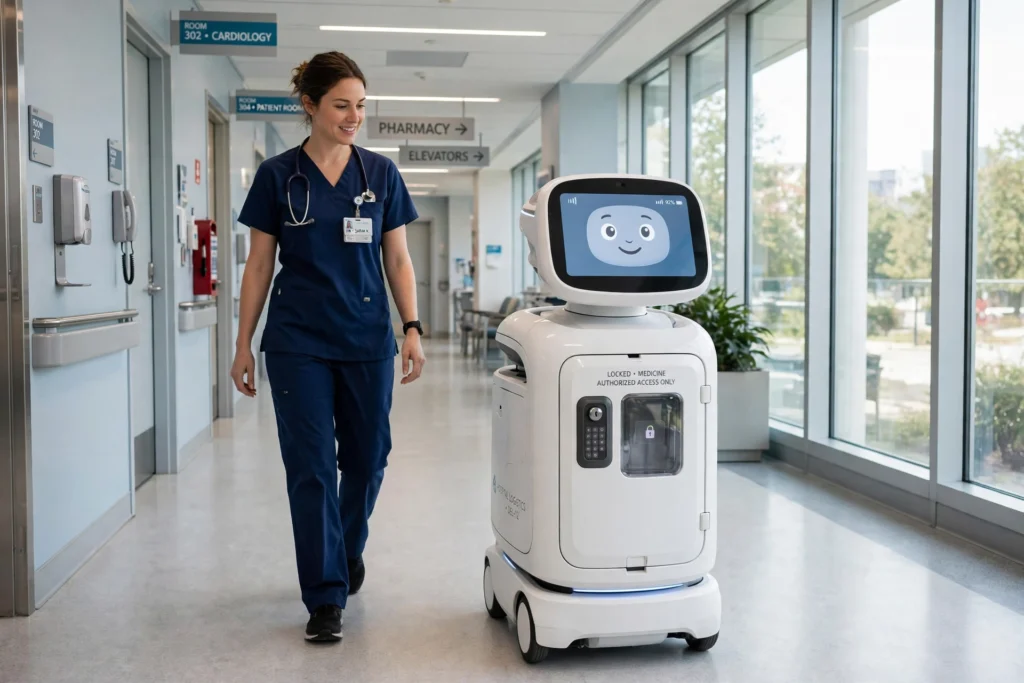
Hospital robots work by following a digital map of the building, sensing people and obstacles as they move, and carrying out routine jobs on their own — delivering medicines, disinfecting empty rooms, or connecting a doctor to a patient by video — so nurses and doctors can spend more time on care.
Note: this article explains how the technology works. It is general information, not medical advice.
Key Takeaways
- Hospital robots mostly do routine, repeatable jobs: deliveries, disinfection, and remote check-ins.
- They navigate with maps, lidar, cameras, and floor sensors, and they slow down or stop near people.
- Delivery robots carry medicines and samples in locked compartments that open only for authorised staff.
- Disinfection robots use UV-C light or sprays in empty rooms, and they never run while people are inside.
- They assist staff rather than replace them, and they still need supervision, charging, and regular checks.
What jobs do hospital robots actually do?
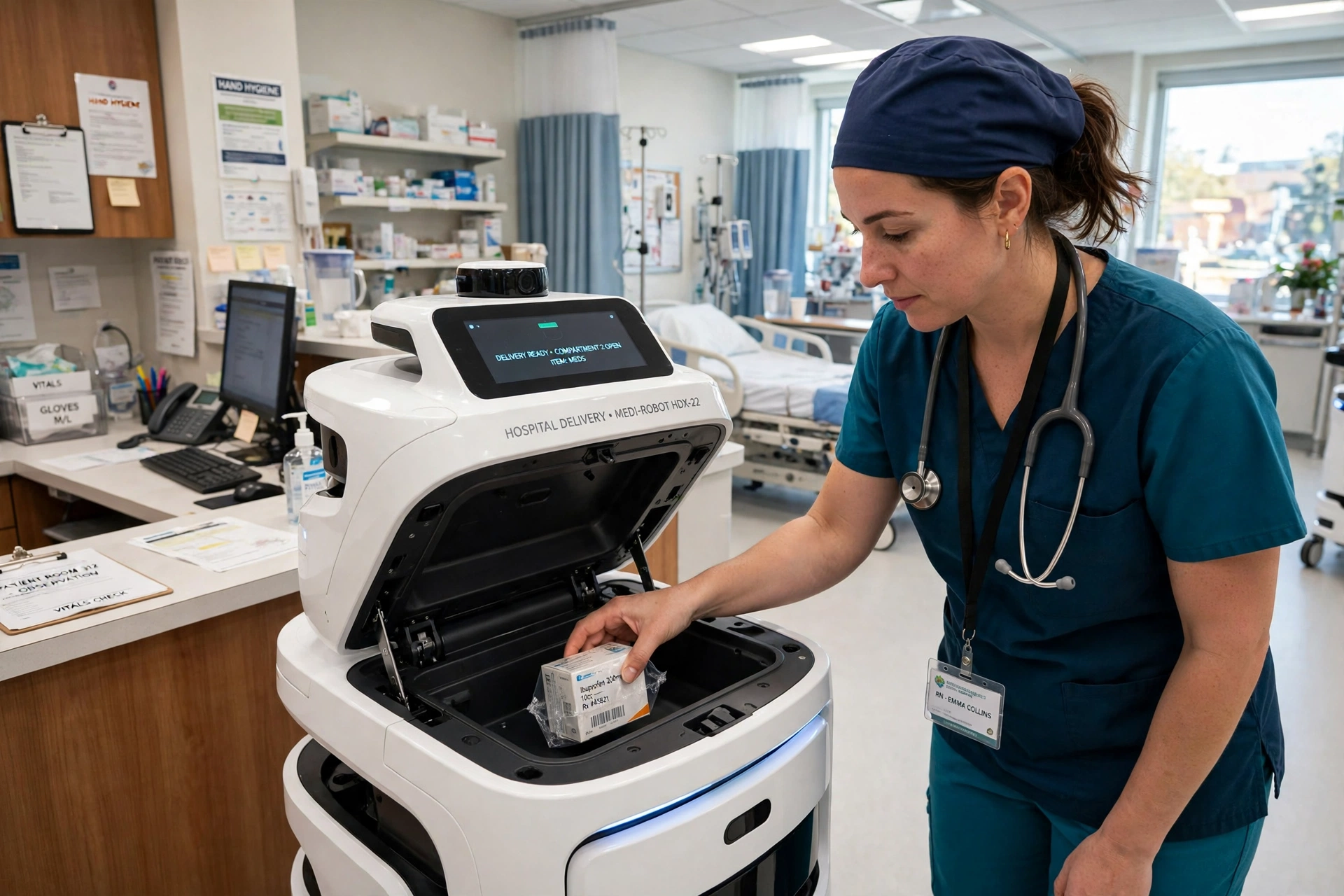
Most hospital robots fall into a few clear groups. Delivery robots are the most common. They carry medicines from the pharmacy, lab samples to the laboratory, and clean linen to wards. Some have locked compartments, so only the nurse or pharmacist with the right code or badge can open them. That matters in a hospital, where the wrong medicine in the wrong hands could cause real harm.
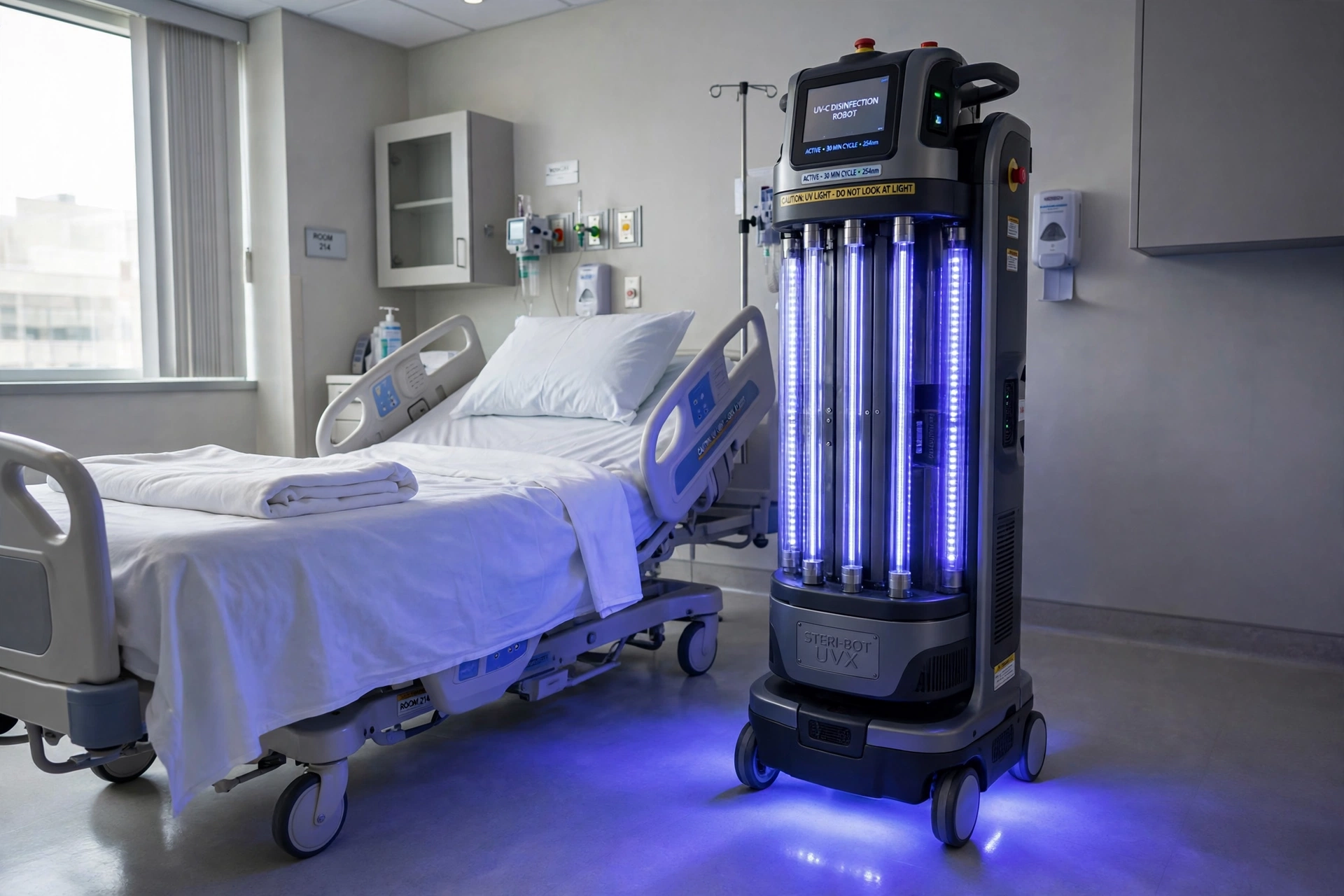
Disinfection robots work differently. After a patient leaves, one rolls into the empty room and shines ultraviolet light across the bed, tables, and floor, damaging the genetic material of germs. The room has to be empty while it runs, and it does not replace ordinary cleaning — it adds an extra pass on top of it.
Then there are telepresence robots — a screen on wheels. A doctor who is off-site can log in, drive the robot to a patient’s bedside, and talk through its camera and speaker, saving a long trip when a quick check is all that is needed.
A smaller group helps with lifting and moving patients, or guides visitors through a large hospital. These are less common, and they usually work with a member of staff close by rather than on their own.
How does a hospital robot find its way around?
A hospital is a busy, changing place, so a robot cannot simply follow a painted line. Before it starts work, staff load a digital map of the building into it — every corridor, ward, lift, and doorway. As it moves, the robot compares what its sensors see with that map to work out exactly where it is.
Lidar is the main tool for this. It sends out pulses of light and measures how long they take to bounce back, building a picture of walls, doors, and furniture. Cameras add detail, such as reading a room number or spotting a person in the corridor. Floor sensors and wheel encoders track how far the robot has travelled and help it keep to a steady path.
When the route is blocked — a bed being wheeled past, a cleaner with a trolley — the robot slows down, waits, or picks another route. If it cannot find a safe way through, it stops and alerts staff. It will not push past a person or squeeze through a gap it cannot measure.
Lifts show how carefully this is planned. In many hospitals, the robot connects to the lift system and calls a lift itself, then rides it to the right floor. In other buildings, a member of staff meets it at the lift instead. Either way, the handover is planned in advance, not left to chance.
How do delivery robots keep medicines safe?
Safety is the part hospitals worry about most, and it shows in how delivery robots are built. Medicines travel in locked compartments, and the robot records who loaded each item and who collected it. Some systems link to the hospital’s own records, so a delivery can be matched to a specific patient and prescription before the compartment opens.
The robot also keeps a log of its journeys: where it went, when it arrived, and whether anything went wrong on the way. If a delivery is delayed, staff can see where the robot is and what is holding it up, rather than guessing. That kind of record matters when the cargo is medicine rather than parcels.
Some medicines and samples also need to stay cool, so certain delivery robots have cooled compartments, much like the pharmacy robots that sort and store drugs in a controlled cabinet. The two often work as a pair: one prepares and stores, the other carries. None of this makes the robot a pharmacist — a person still checks the prescription, loads the right items, and confirms the delivery.
What about disinfection robots — how do they clean a room?
A disinfection robot does not scrub or mop. Its job is to reach surfaces and corners that a person might miss, using light or mist. The UV-C models carry tall lamps that give off short-wave ultraviolet light. The robot moves to the middle of the room, or to a few set positions, and runs a timed cycle while the room stays empty.
The light needs a clear line of sight to work, so a bedside table hidden behind a curtain gets less of it than an open floor. That is why hospitals run these robots after normal cleaning, not instead of it.
Spray-based models release a fine mist of disinfectant and let it settle, then the room needs time to air out. Both types follow strict rules about who can start a cycle and when the room is safe to enter again, with a door sensor or warning sign so nobody walks in by mistake.
Do hospital robots replace nurses and doctors?
No — and that is worth saying plainly. A hospital robot takes over the walking, carrying, and waiting parts of a job, not the judgement parts. It cannot notice that a patient looks worse than yesterday, comfort someone who is frightened, or decide that a prescription needs a second look. Those are human decisions, and hospitals keep them with people.
What the robots do change is how a shift feels. A nurse who used to walk to the pharmacy four times a night can stay on the ward instead. A cleaner who used to wait for a room to be free can move on to the next job while the disinfection robot runs its cycle. The gains are measured in steps saved and minutes returned, not in staff removed.
There are limits, too. A robot can get stuck if a corridor is rearranged or a lift is out of service, and its battery needs charging, its sensors cleaning, and its software updating. Hospitals that use these machines well have a clear plan for all of that.
What are the limits and risks?
The biggest limit is that a hospital is unpredictable. People move quickly, emergencies change priorities, and equipment gets left in corridors. A robot that copes well on a quiet night may struggle during a busy morning round, so good systems are tested in real wards before they are trusted with regular work.
Privacy is another concern. A robot with cameras rolling through a ward is collecting images of patients and staff, so hospitals need clear rules about what is recorded, where it is stored, and who can view it. The same applies to telepresence robots, which carry live video between rooms.
Cost is the third limit. The robot itself is only part of the price — there is installation, mapping, training, and maintenance. Smaller hospitals often start with one job, such as pharmacy deliveries, and expand only if that works well.
Finally, safety rules for UV light and for moving machines in public spaces have to be followed closely. A disinfection robot running in an occupied room, or a delivery robot blocking a fire exit, would be a serious failure — which is why these robots are supervised, logged, and checked regularly.
FAQs
How fast can a hospital delivery robot move?
Usually at a slow walking pace, around one metre per second or less. It moves more slowly in crowded corridors and speeds up only on clear, straight stretches. The point is steady, predictable movement, not speed.
Can a hospital robot use a lift on its own?
In many hospitals, yes. The robot connects to the lift controls, calls a lift, and rides it to the right floor. In other buildings, a member of staff meets it at the lift. Which setup is used depends on the building and the robot model.
Do disinfection robots replace manual cleaning?
No. They add a disinfection pass after a room has been cleaned by hand. Manual cleaning removes dirt and visible mess first; the robot’s light or mist then reaches surfaces a person may have missed.
Are medicines safe inside a delivery robot?
Deliveries travel in locked compartments that open only for authorised staff, and the robot logs who loaded and collected each item. A person still checks the prescription and confirms the delivery.
What happens if a hospital robot breaks down mid-corridor?
It stops safely, alerts staff, and waits. Hospitals keep a plan for this: someone moves it aside, checks the fault, and either restarts it or sends it for repair. Its deliveries can be re-routed to another robot or carried by hand in the meantime.
Conclusion
Hospital robots work by combining a map of the building, sensors that watch the space around them, and a simple, repeatable job — carrying, cleaning, or connecting people. They are at their best on routine runs that would otherwise eat into a nurse’s shift, and they are least useful where judgement, comfort, or quick decisions matter.
If you are weighing up whether a hospital needs one, start with a single job that is easy to measure, such as pharmacy deliveries between two points, and count the trips it saves in a week. If that number is real and the safety rules hold up in practice, you have a solid case for keeping it.
Related reading: Pharmacy Robots | Delivery Robots | Robot Arms | Warehouse Robots
Further reading: Britannica: Robotics | IEEE Spectrum: Mobile Dexterous Robots