Note: This article is general information about pharmacy technology. It is not medical advice. Always follow your pharmacist’s instructions and check your own prescription label before taking any medicine.
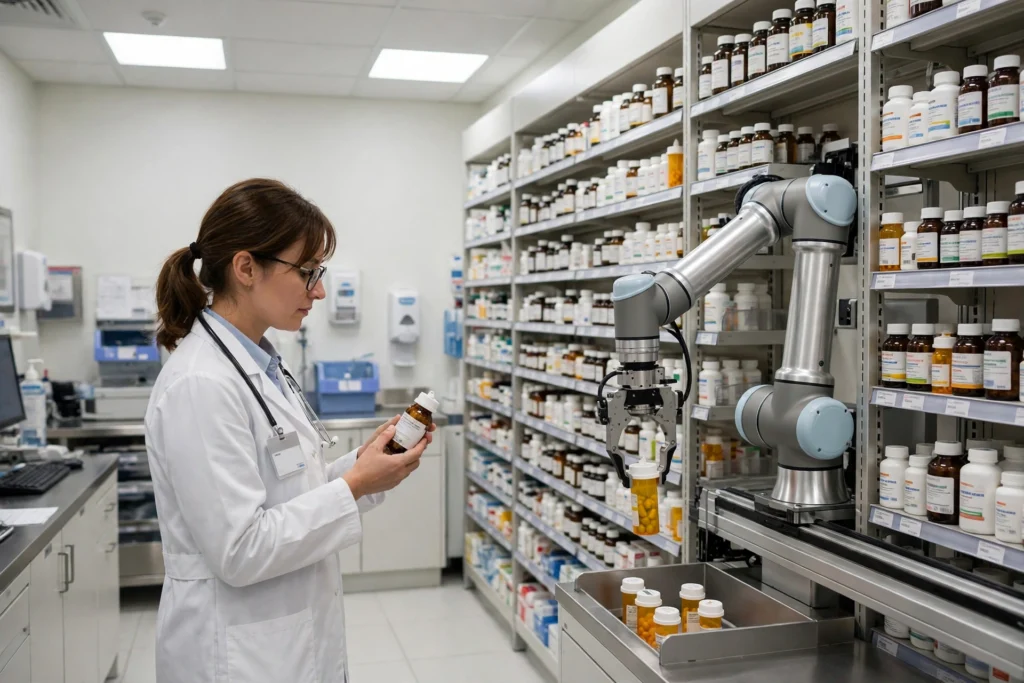
A pharmacy robot is a machine that stores, counts, sorts, and dispenses medicines under software control, while a pharmacist still checks prescriptions and answers patient questions. It reads a prescription order, finds the right product by barcode, counts or picks the exact amount, labels the container, and sends it for a final human check before it reaches you.
Key Takeaways
- Pharmacy robots handle the repetitive physical work: storage, counting, picking, and labelling.
- Barcodes, cameras, and software checks help match the right medicine, strength, and patient.
- A pharmacist still reviews prescriptions, checks interactions where relevant, and counsels patients.
- Robots do not replace clinical judgement, especially for complex, compounded, or unusual prescriptions.
- If anything on your label looks wrong, stop and ask the pharmacist before leaving.
What exactly is a pharmacy robot?
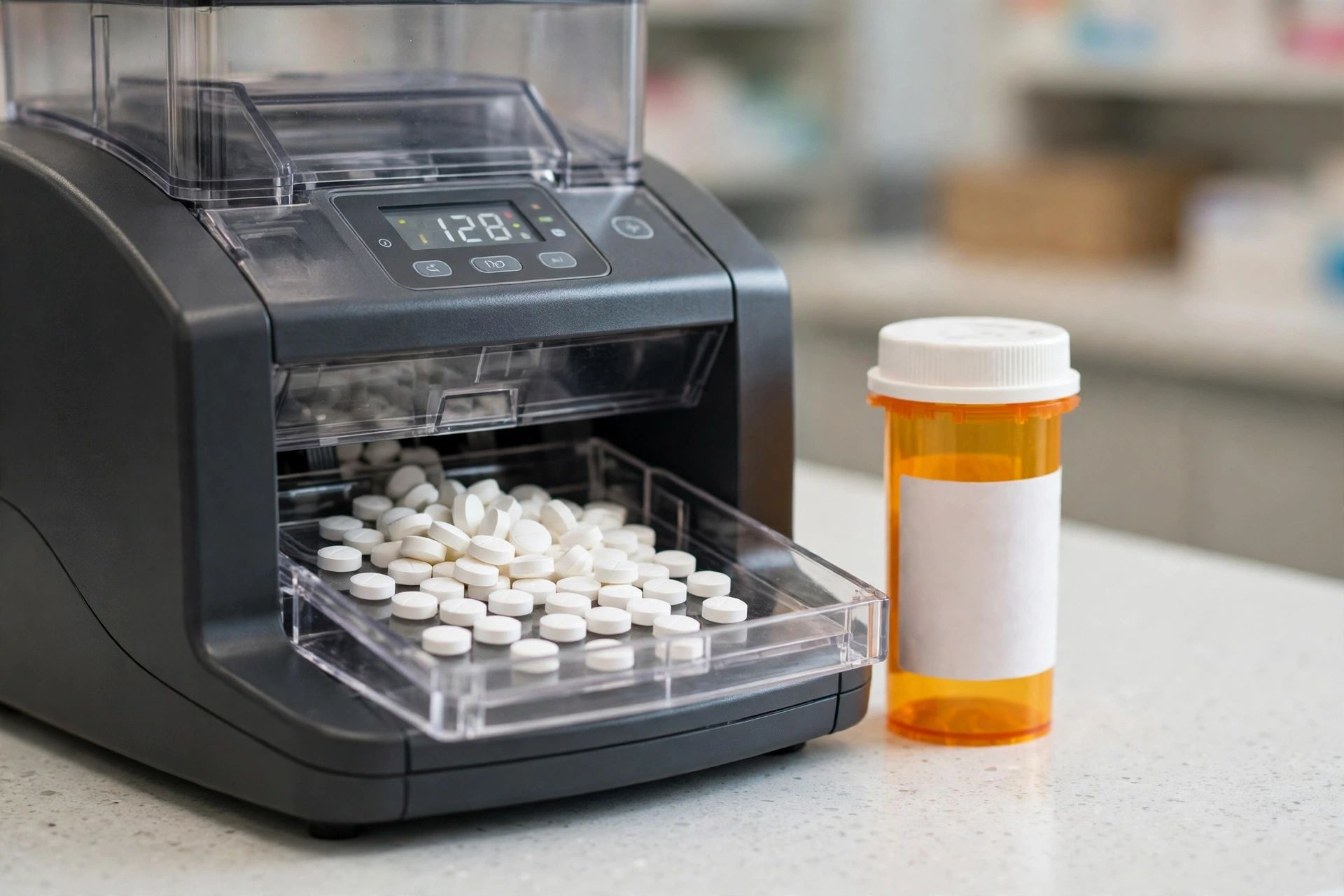
In simple terms, a pharmacy robot is a controlled storage and dispensing system, not a human-shaped helper wandering the shop floor. Some are large cabinets with rows of shelves and a moving arm. Others are smaller counting machines on a counter. Larger hospital systems may also include automated cabinets on wards, where staff collect doses that have already been approved.
The shared idea is the same: keep medicines organised, traceable, and hard to mix up. Robotics, in the broad sense, is the design and use of machines to perform tasks once done by people, and pharmacy systems apply that idea to a very careful job. You can read a general overview of robotics on Britannica: robotics overview
How does a pharmacy robot receive a prescription?
It starts with an order, not with the robot reaching for a shelf on its own. A doctor’s prescription, or a repeat order, enters the pharmacy system. The software checks the basics: the patient’s name, the medicine, the strength, the quantity, and any directions on file. Staff may still need to resolve a missing detail, an unclear instruction, or a product that is out of stock.
Once the order is confirmed, the system creates a dispensing task. That task is linked to a specific product code, so the robot is not guessing from a drug name alone. Think of it like a warehouse pick list with one extra layer of care: every item must match exactly, because a near match is not good enough here. That link to warehouse-style handling is no accident. Systems that move stock in warehouses, such as the ones in How Do Warehouse Robots Work?, use similar ideas about location, tracking, and picking, even though the products and safety rules are very different.
How does the robot find and pick the right medicine?
Most pharmacy robots store medicines in known locations. When a task arrives, the arm, conveyor, or picking mechanism travels to that location. It may use a gripper, a chute, or a cassette that holds one specific product. The product’s barcode is scanned again at pick-up, so the system can catch a mismatch before the medicine moves any further.
This is where robot arms earn their keep. A pharmacy arm does not need the strength of a factory arm, but it does need the same kind of controlled, repeatable movement. How Do Robot Arms Work? explains joints, motors, and grippers in plain language, and those same parts, scaled down and enclosed, help a pharmacy system pick a bottle without dropping it or grabbing its neighbour.
Some systems do not pick whole bottles at all. They dispense tablets from a calibrated cassette, count them with a sensor or camera, and drop them into a vial. Others handle sealed boxes and send them to the counter by conveyor. The exact method depends on the pharmacy, the medicine, and local rules.
How does it count tablets so accurately?
Counting by hand is slow, and it is easy to lose track after a long shift. Automated counters use a few methods, often together. A vibrating tray can separate tablets so a sensor counts them one by one. A camera can watch the stream and compare what it sees with the expected count. A cassette system can dispense a set number from a measured mechanism.
Pharmacy automation has a long history here, from early tablet counters to today’s enclosed robotic systems.
What happens after the medicine is picked?
Picking is only half the job. The robot, or the connected labelling system, usually prints a label with the patient’s name, the medicine, the strength, the directions, and other details required by the pharmacy. The container is then checked, sealed or bagged, and placed ready for collection or delivery.
In a hospital, the next step might be delivery to a ward cabinet or a trolley. In a community pharmacy, it is usually a handover at the counter. Either way, the final check matters more than the speed of the machine. A pharmacist, or a trained member of staff following the pharmacy’s checking procedure, reviews the label against the prescription before the medicine is handed over. That is also your chance to ask questions, which no robot can answer for you.
How do pharmacy robots improve safety?
They help mainly by reducing the chances of a simple slip: picking the wrong shelf, miscounting, or mixing up two similar-looking boxes. Barcodes add a machine-readable identity that eyes alone can miss. Fixed storage locations reduce hunting through crowded shelves. Software logs create a trail, so staff can trace what was dispensed, when, and from which stock.
What can pharmacy robots not do?
Plenty. They cannot judge whether a prescription makes sense for your health history, spot a risky combination on their own, or explain side effects in plain language. They cannot mix every kind of medicine, prepare every sterile product, or handle a prescription that needs a judgement call. Controlled medicines, refrigerated products, and complex preparations often stay partly or fully manual, depending on the rules where you live.
Pharmacy robots sit in a wider family of service robots. Hotel robots carry items to rooms, and robot vacuums clean floors on their own. Each one trades a repetitive physical task for software control, and each one still needs people to supervise it and step in when something unusual happens. How Do Hotel Robots Work? How Do Robot Vacuums Work?
FAQs
- Do pharmacy robots replace pharmacists? No. They take over storage, counting, and picking, while pharmacists review prescriptions, check finished orders, and advise patients. The robot handles the repetitive work; the pharmacist handles the judgement.
- Are medicines from a robot safer? They can reduce common picking and counting slips, thanks to barcodes and second checks. They are not risk-free, though, and they still depend on correct orders, clean equipment, and a final human check.
- Can a pharmacy robot handle every prescription? No. Some medicines need compounding, sterile preparation, cold storage, or special handling that a standard robot cannot do. Those orders are prepared by staff, sometimes with different equipment.
- What happens if the robot picks the wrong item? A barcode or camera check should flag a mismatch, and the order should stop for review. If a wrong item ever reached you, contact the pharmacy at once and do not take the medicine until staff have checked it.
- Will pharmacy robots make waiting times shorter? Often, yes, for routine orders, because counting and picking are faster and staff can focus on checking and counselling. Waiting times still depend on stock, prescription checks, and how busy the pharmacy is that day.
Conclusion: a practical next step
Pharmacy robots work by turning a prescription into a tracked task: find by barcode, pick or count with sensors, label, and send for a human check. The technology is most useful when it is boring and consistent, leaving people free to do the careful, human part of pharmacy work.
Next time you collect a prescription, take thirty seconds to read the label aloud in your head: your name, the medicine, the strength, and the directions. If all four match what you expected, you have done the simplest and most useful check of all. If anything does not, ask the pharmacist before you leave. That habit matters whether a robot, a person, or both prepared your order.