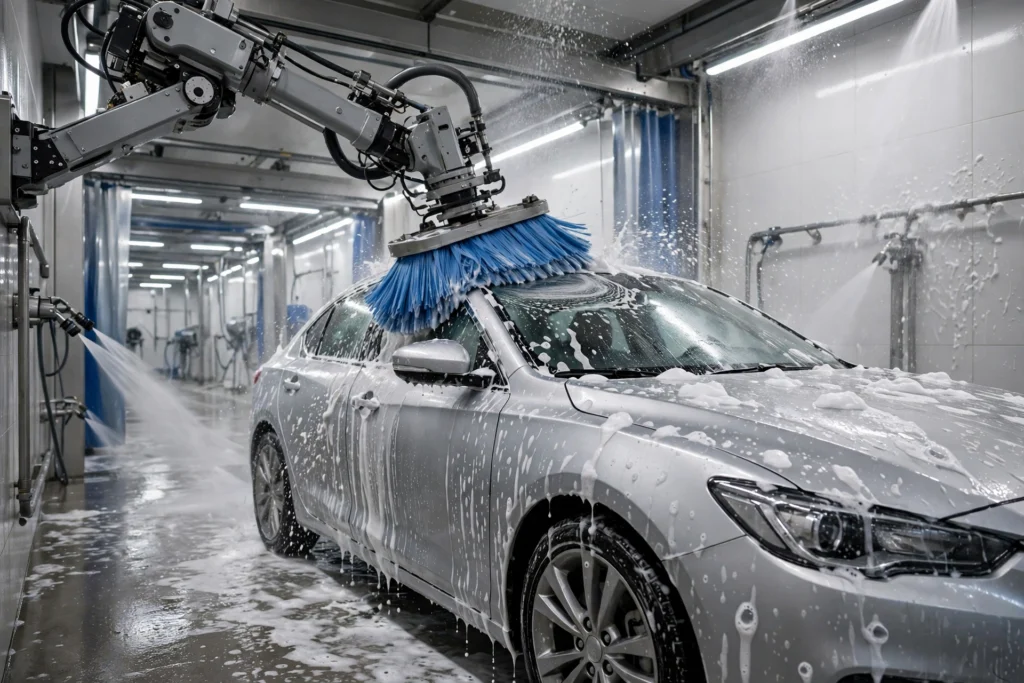
Car washing robots work by first sensing the shape of your car, then moving soft brushes, cloth strips, or high-pressure jets along that shape in a set order, and finally blowing the water off with large dryers. You drive in, put the car in neutral, and the machine does the scrubbing, rinsing, and drying while you sit still.
Behind those calm few minutes is a tidy chain: measure the car, loosen the dirt, wash it off, rinse it clean, and dry it before spots form. Each tool has to know where the car ends and empty air begins.
Key Takeaways
- Car washing robots first map your car’s length, height, and shape with sensors, then follow that outline.
- Soft brushes, cloth strips, or high-pressure water jets do the cleaning, depending on the wash type.
- Soap and presoak loosen dirt before the brushes touch the paint, which helps reduce scratching.
- A rinse, a wax or protectant coat, and powerful air dryers finish the job.
- Mirrors, roof racks, loose trim, and very dirty cars still need a quick check before you drive in.
What exactly is a car washing robot?
A car washing robot is not usually one machine with arms like a factory robot. Most of the time it is a gantry — a large frame that rolls over your car — or a tunnel of fixed arches that your car moves through on a conveyor. Some newer washes use robot arms mounted on rails, but the idea is the same: a machine moves cleaning tools along the car’s shape without a person holding them.
In an in-bay automatic, you park and the machine moves around you. In a tunnel wash, you sit still on a conveyor while the car glides past brushes, arches, and dryers. Tunnel washes handle more cars per hour; in-bay machines take up less space. Our guide to What Is Robotics? explains the parts most robots share.
How does the robot know the shape of your car?
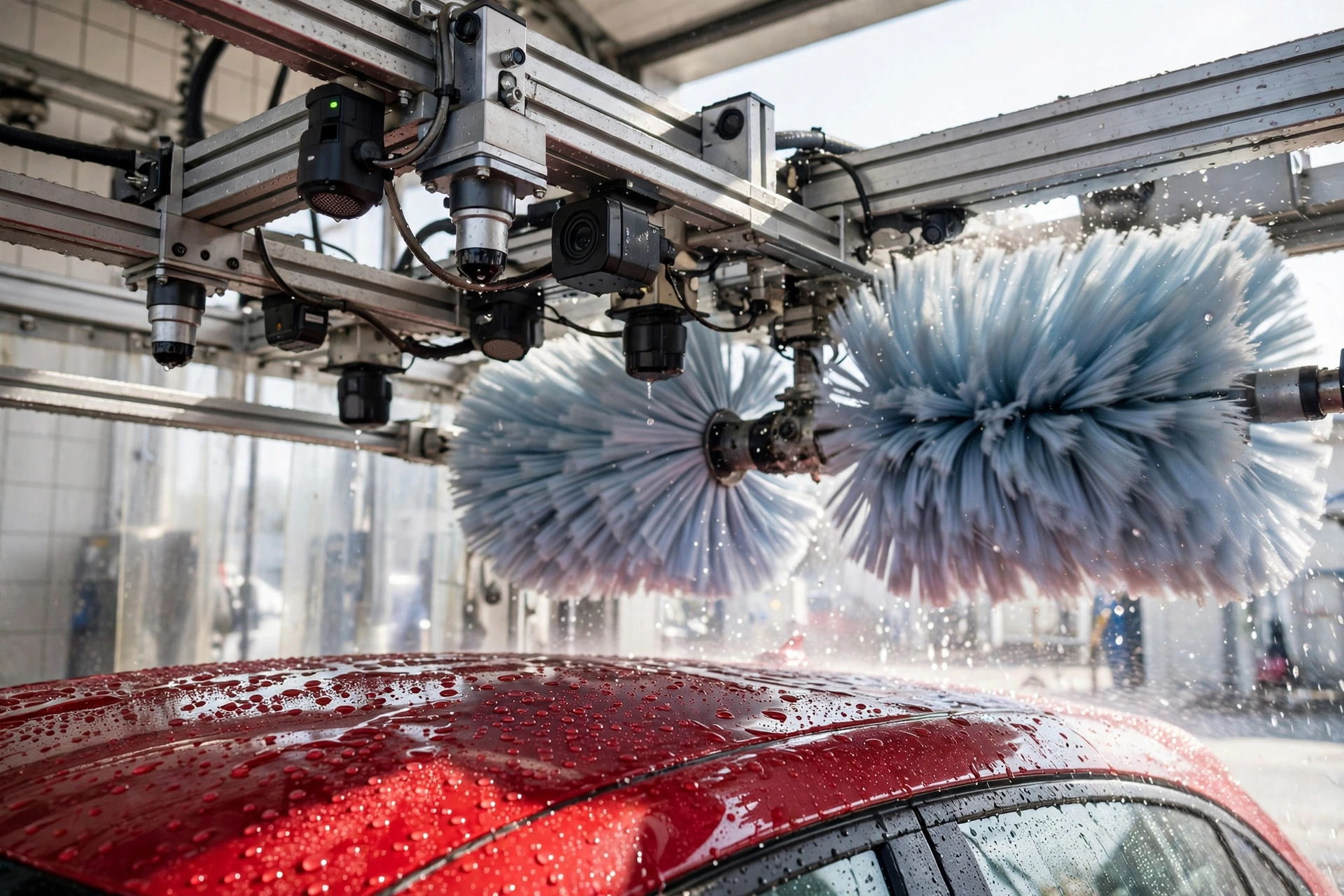
Before anything touches the paint, the machine needs a map. Light curtains — rows of light beams — detect where the car starts and ends. Ultrasonic sensors bounce sound off the bodywork to judge distance, and some systems use cameras or laser scanners to outline the roof, bonnet, and boot.
That outline matters: a hatchback, a tall van, and a low sports car all need the brushes and dryers at different heights. The controller stores the profile and adjusts each brush and dryer to follow it. The sensors keep working during the wash, too, and should pull back if a mirror sticks out further than expected. It is not perfect — a loose aerial can still confuse it — so fold mirrors in and remove loose items first.
What do the brushes and jets actually do?
Cleaning happens in stages. First comes a presoak: diluted soap that sits on the paint and starts to loosen road film, bugs, and salt. Then the main wash follows, and this is where the two big approaches split.
In a soft-touch wash, large spinning brushes or hanging cloth strips make contact with the car. The brushes are usually soft foam rather than stiff bristles, and they spin while the gantry moves. Wheels get their own smaller brushes. In a touchless wash, nothing solid touches the paint: high-pressure jets spray water and stronger detergents from several angles. That lowers the risk of swirl marks but can struggle with baked-on grime.
Either way, the rule is the same: soap loosens, the brush or jet removes, and the rinse carries it away. A brush pressing on dry dirt would grind it into the paint, so the presoak is what makes contact safe. A very muddy car often comes out with a few marks left, because one pass cannot always shift a thick layer.
How does the rinse, wax, and drying stage work?
Once the dirt is off, the machine rinses the car with clean water, often in more than one pass. The first rinse removes soap and loose dirt; a later spot-free rinse uses filtered water with most minerals removed, so it dries without leaving pale spots. That filtered rinse is why a good automatic wash can leave fewer water marks than a garden hose at home.
Some washes then add a wax or sealant: a thin spray that a final brush or cloth pass spreads evenly. It will not last as long as a hand-applied wax, but it helps water bead and roll off, which makes drying work better.
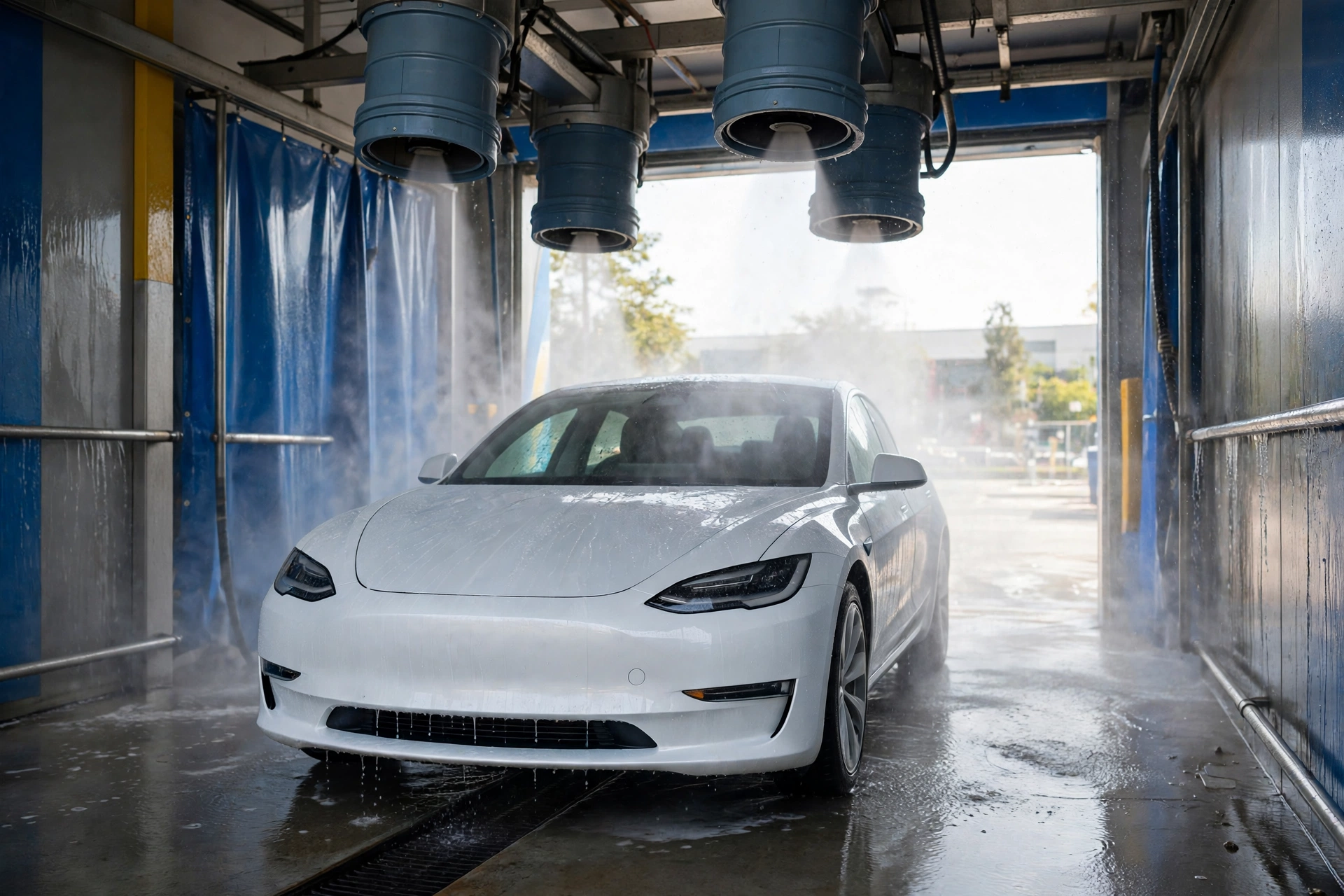
Large blowers — sometimes shaped to follow the roofline — push a strong stream of air over the car, driving water off the roof, bonnet, and sides. Some use heated air; others rely on volume and speed. If you have ever driven out and found a stripe of water across the rear window, that is usually water trapped in a mirror housing that escaped once you picked up speed.
Are car washing robots safe for your paint?
Usually yes, with a few caveats. Modern soft-touch washes use foam and cloth rather than the stiff nylon brushes of decades ago, and the soap and water keep grit moving off the surface instead of dragging across it. A well-maintained wash, with clean brushes and fresh water, is generally kinder to paint than a dirty sponge at home.
The risks come from maintenance and the car’s condition. Brushes that have picked up grit can leave fine swirl marks over time, and cars with peeling paint, loose trim, or parts that stick out are more likely to catch on a brush. Touchless washes avoid contact, but they use stronger detergents and higher pressure, which can be harsher on older wax or tired paint.
So the practical rule is simple: if your paint is in good shape and the wash looks clean and well kept, a robot wash is a reasonable choice. If your car has flaking paint, a loose bumper, or a wobbling roof rack, sort that first — or choose a hand wash where a person can see the problem. Cars with special paint or a matte finish need a check of the maker’s guidance first.
What about water use, and how is this different from other cleaning robots?
A professional car wash uses a lot of water per car, but it usually uses it more carefully than washing at home. Many modern washes collect the rinse water, filter it, and reuse it for the early stages, keeping fresh water for the final rinse. You can read more in Wikipedia’s overview of the car wash.
The job differs from other cleaning robots in one way: the thing being cleaned moves through the machine, or the machine moves around a large, fragile object that cannot be picked up. A pool cleaning robot drives around inside a fixed space — our guide to How Do Pool Cleaning Robots Work? shows how its brushes and filter work underwater. A warehouse robot moves goods around a building, following maps and floor markers; see How Do Warehouse Robots Work?, and the arms that grip and lift in How Do Robot Arms Work?. What ties them together is the same loop: sense, plan, and check.
Frequently Asked Questions
Will a car washing robot scratch my car?
It can leave fine marks over many visits, but a well-maintained modern wash with soft foam brushes and clean water is much gentler than older washes. The biggest risk is grit trapped in a brush. If your paint is already damaged, get that fixed first.
Is a touchless wash better than a brush wash?
It depends. Touchless washes avoid contact, so they carry less risk of swirl marks, but they may leave baked-on dirt behind. Brush washes usually clean better on a dirty car, but they depend on clean, soft brushes.
How long does a robot car wash take?
Most take a few minutes from entry to exit, with tunnel washes usually faster per car. A basic wash is quickest; adding wax or extra drying passes adds time. Queuing at busy times often takes longer than the wash itself.
Can car washing robots wash any car?
Most standard cars, SUVs, and small vans fit, but very tall vehicles, cars with roof tents or large roof boxes, and vehicles with loose trim may not suit one. Check the height and width limits, fold your mirrors in, and remove loose items first.
Do I need to do anything before driving in?
Yes: fold in the mirrors, close windows and the sunroof, remove or secure loose items such as aerials and roof racks, and check for peeling paint. Put the car in neutral if asked, take your foot off the brake, and follow the instructions on screen.
Conclusion: try one wash with your eyes open
Car washing robots work by measuring your car, loosening dirt with soap, cleaning with soft brushes or high-pressure jets, rinsing with clean water, and drying with powerful blowers. It is a fast, repeatable process, and for most cars in good condition it does a decent job in a few minutes. Its limits are the same as any machine: it follows a programme, it cannot see a loose trim piece the way you can, and it will not stop to scrub one stubborn spot.
A practical next step: next time you use one, watch the stages and check the result afterwards — the roof, the lower doors, water around the mirrors, and whether the wheels came clean. If it is good, you have found a wash that suits your car; if not, try a different type and compare. For wider background, Britannica’s robotics overview is a solid starting point.