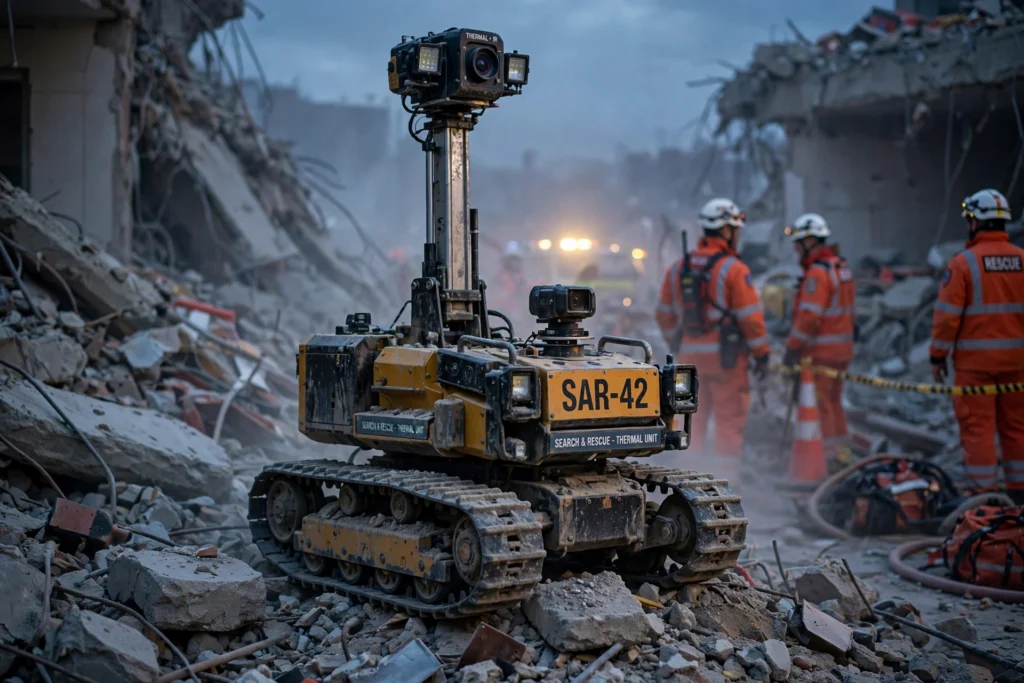
Search and rescue robots are machines built to reach people trapped where human rescuers cannot safely go. After an earthquake, flood, or building collapse, they crawl through rubble, fly over wreckage, and swim through floodwater, using thermal cameras, microphones, and gas sensors to find survivors. They do not replace rescue teams — they go in first.
Key Takeaways
- Five main forms: tracked ground robots, legged robots, drones, snake robots, and water robots.
- They find people with thermal cameras, microphones, and carbon dioxide sensors, not ordinary eyesight.
- Most are still driven by a human, often over a cable, because radio dies inside collapsed concrete.
- First used after the World Trade Center collapse in 2001; used in earthquakes and nuclear accidents since.
- Battery life, broken communications, and cost are still the biggest limits.
What kinds of search and rescue robots are there?
There is no single rescue robot. Disaster sites are too varied for one machine, so teams use different robots for different jobs.
Tracked ground robots are the workhorses. They look like small tanks, with wide tracks that grip broken concrete and climb debris, and they carry cameras, a thermal sensor, and a two-way speaker, so an operator can see into a void and talk to anyone trapped inside. Some carry a small gripper arm — the same mechanism found on industrial robot arms — for moving light debris or passing in a phone.
Legged robots walk instead of rolling. Four-legged machines such as Boston Dynamics’ Spot pick their way across uneven rubble and keep balance when the ground shifts. They are slower on flat ground, but cope better with stairs and gaps.
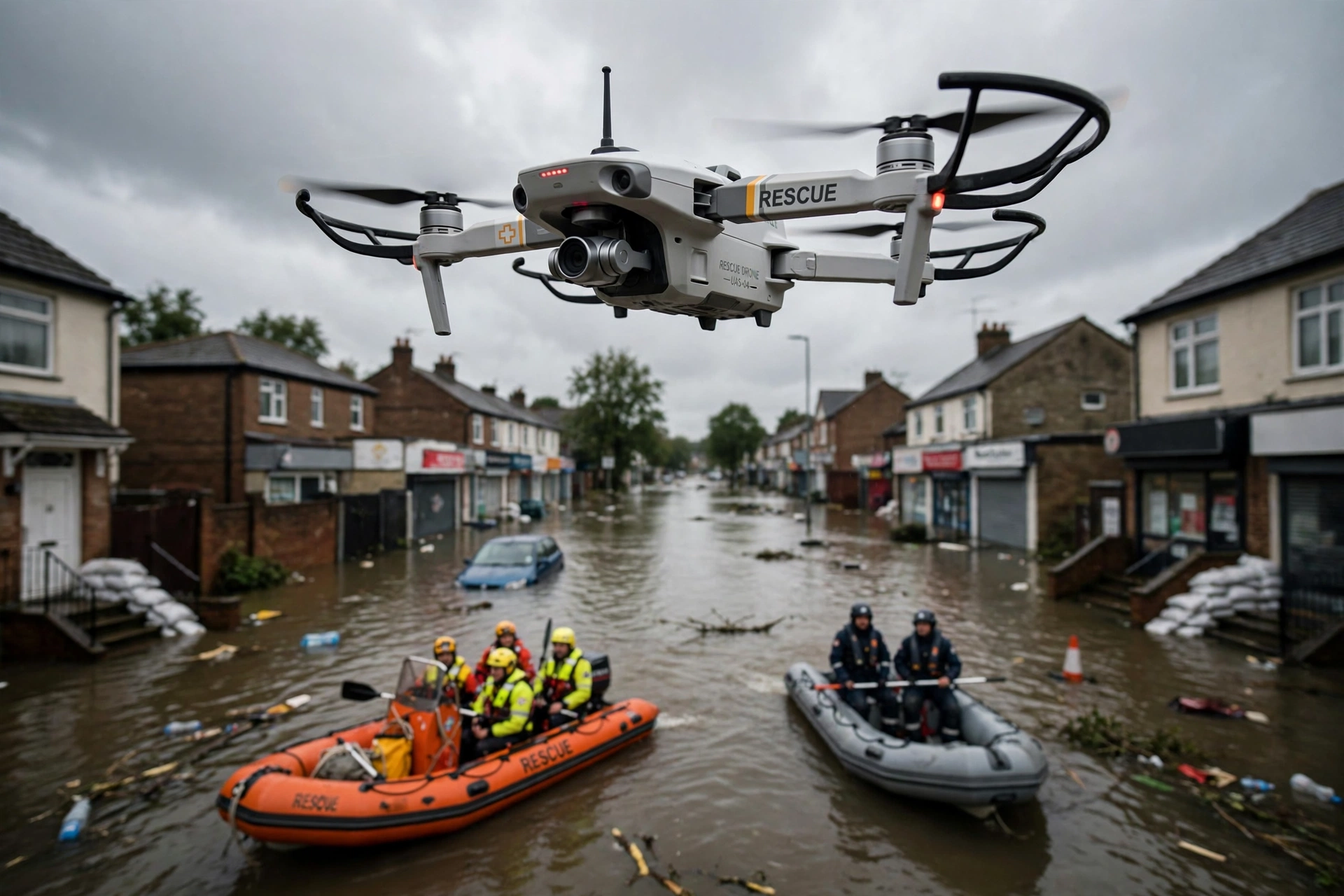
Drones cover ground fast from above. A quadcopter can map a flooded neighbourhood in minutes or spot a heat signature on a rooftop. The weakness is endurance: most fly for well under an hour.
Snake robots are built for gaps nothing else can enter, sliding through cracks with a camera and a light to check whether anyone is alive in a void. Water robots handle floods, looking for people in murky water and carrying lines to stranded swimmers.
| Robot type | Where it works best | Main strength | Main weakness |
|---|---|---|---|
| Tracked ground robot | Collapsed buildings, rubble piles | Stable, carries heavy sensors | Slow, needs a clear entry point |
| Legged robot | Uneven rubble, stairs, debris | Steps over obstacles, keeps balance | Slower on flat ground, costly |
| Drone | Wide areas, floods, rooftops | Covers ground fast, sees from above | Short battery life, bad in high wind |
| Snake robot | Tight voids and cracks | Fits where nothing else can | Very short reach, carries almost nothing |
| Water robot | Floods, rivers, shorelines | Works where boats cannot go | Struggles in strong currents and debris |
How do they find someone who can’t call for help?
A trapped person is often unconscious, buried, or too weak to shout, so rescue robots search with senses humans do not have.
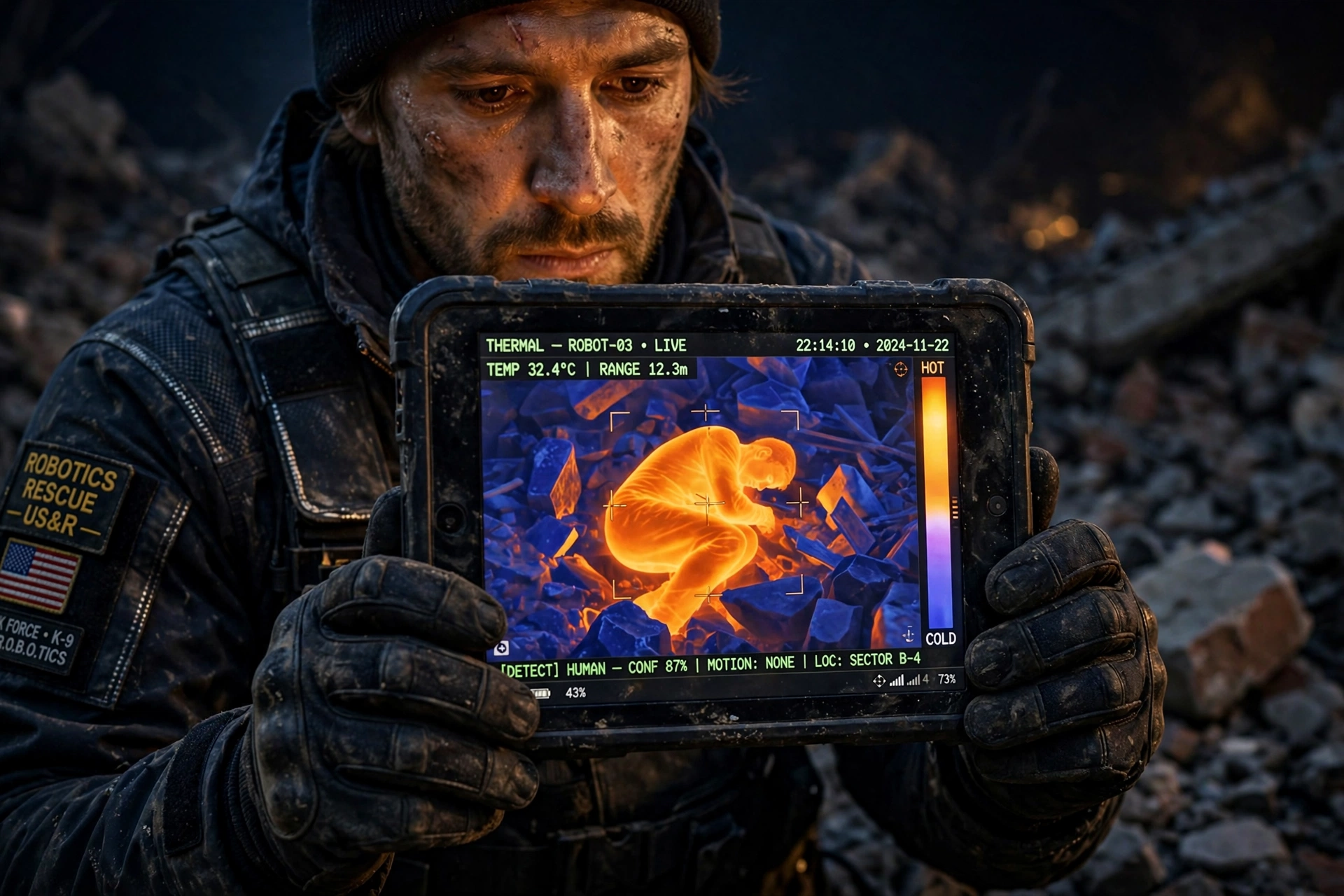
Thermal cameras come first. A human body gives off heat, and a thermal camera can pick that out against cold concrete, even in darkness or thick dust. It is not foolproof — hot pipes and fires can confuse it — so teams never rely on heat alone.
Microphones come next, picking up tapping, breathing, or a faint voice through debris, while an array helps the operator judge direction. Carbon dioxide sensors add a third check: a rising reading in a sealed void suggests someone is alive inside, even when no camera can see them. Gas sensors also warn the team about leaking fuel or chemicals before a human rescuer goes in.
Mapping ties it together. As the robot moves, it builds a 3D map using laser scanners and cameras, a technique called SLAM, so the operator knows where it has searched and how to get back out. The same obstacle sensing keeps warehouse robots moving safely around shelves, and on a rescue robot it stops the machine driving into a hole it cannot climb out of. Our guide to how robots avoid obstacles explains the sensors behind this. Similar sensor packages are used outside disaster zones too — wind turbine robots carry them to inspect blades high above the ground.
Who actually drives the robot?
Most search and rescue robots are still driven by a person. A disaster site is the worst place for full autonomy: the ground is unpredictable, the map does not exist yet, and a wrong turn can trap the robot or make a collapse worse.
The operator sits a safe distance away, steering by controller while watching the robot’s cameras. In open areas the link is wireless, but inside a collapsed building radio fades within a few metres — concrete, steel, and wet debris block it. So many rescue robots are driven over a cable instead, which carries video and commands through the rubble but also limits how far the robot can go.
Semi-autonomy fills the gap: the robot handles balance and obstacle avoidance itself, while the human decides where it goes.
Where have rescue robots really been used?
The field began after the World Trade Center collapse in 2001, when researchers sent small tracked robots into the rubble to inspect voids — proving a robot could return pictures from places no person could enter.
Since then, rescue robots have worked after major earthquakes in Japan and Turkey, searching collapsed buildings and mapping damage, and after the Fukushima accident, where they entered areas too radioactive for people. Drones are now a familiar sight at floods and wildfires, guiding rescue boats to people stranded on rooftops.
None of this means robots save lives alone. Every deployment has been a team effort: the robot finds and reports, and trained people do the rescue.
What still limits rescue robots today?
Battery life comes first: a tracked robot may run for a few hours, but a drone often manages less than one, with nowhere to recharge at a disaster site. Communications are second — the tether that keeps a ground robot connected also limits its range. Cost and training are third: a capable rescue robot is expensive, and driving one well under pressure takes regular practice, so many services share a few robots across a region. Finally, the environment fights back: dust blinds cameras, water shorts electronics, and rubble snags tethers.
What comes next for rescue robots?
The most promising direction is teamwork between machines: groups of smaller robots that spread out, share what they find, and cover a site faster than one machine could — if one fails, the others carry on. Sensors are getting smaller and cheaper too, so useful rescue robots should reach more fire services, not just specialist units. Some teams are also testing robots that work alongside rescue dogs, carrying equipment so the dog can search longer.
Frequently Asked Questions
How fast can a search and rescue robot find someone?
It depends on the site. A drone can scan a rooftop in minutes; a tracked robot may take an hour to search one collapsed room carefully. The robot narrows the search so rescuers spend time in the right place.
Can rescue robots work without a human operator?
Not reliably yet. Most are teleoperated, with the robot handling balance and obstacle avoidance. Research robots can explore tunnels with limited supervision, but field teams keep a person in control during real rescues.
How much does a search and rescue robot cost?
Prices vary widely, from a few thousand for a capable drone to far more for a tracked robot with thermal imaging and an arm. Training, maintenance, and spare parts add up over the years.
Do rescue robots replace rescue dogs?
No. Dogs are better at scent tracking over wide areas. Robots are better at entering spaces too small, hot, or unstable for any living creature. Many teams use both together.
What happens if a rescue robot breaks inside a collapsed building?
The team tries to pull it out on its tether. If it cannot be recovered, it is usually left in place — the search for people takes priority over recovering equipment.
Conclusion
Search and rescue robots will not replace human rescuers, and they are not meant to. Their value is narrower and more important: they go where people cannot, see what people cannot see, and buy time for the teams that do the rescuing. The next step is practical. If you work with a local emergency service, community team, or school, ask whether they have a drone programme or robot unit — and if not, what it would take to start one.