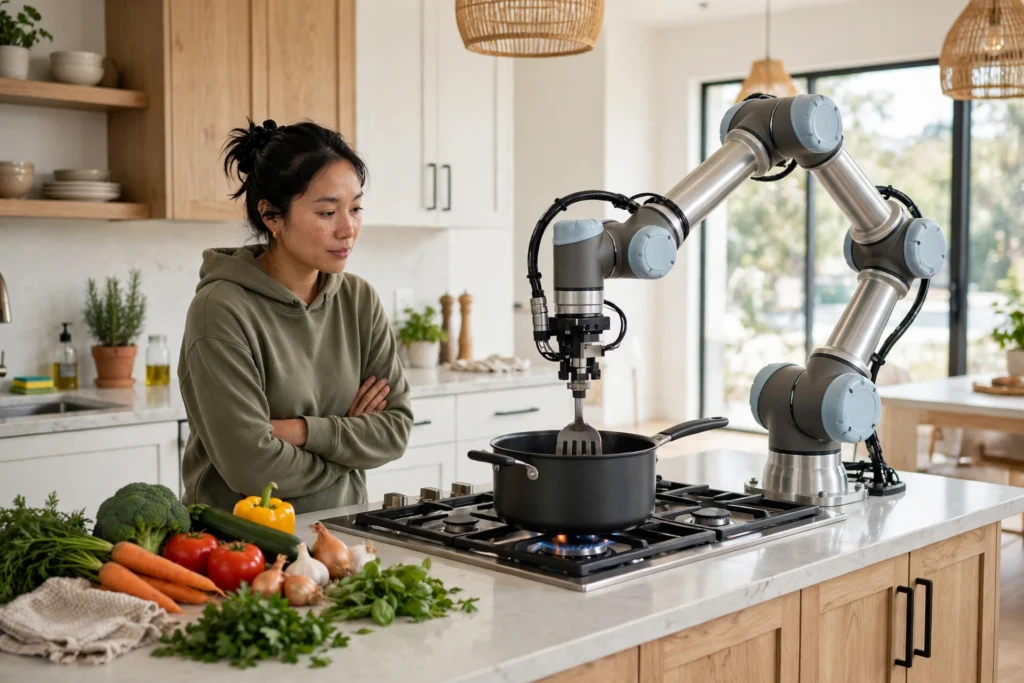
A cooking robot is a machine that follows a recipe step by step, using motors, sensors, and heat control to prepare food. It turns a recipe into timed actions — pick up an ingredient, stir for a set time, hold a temperature — rather than tasting or improvising like a home cook.
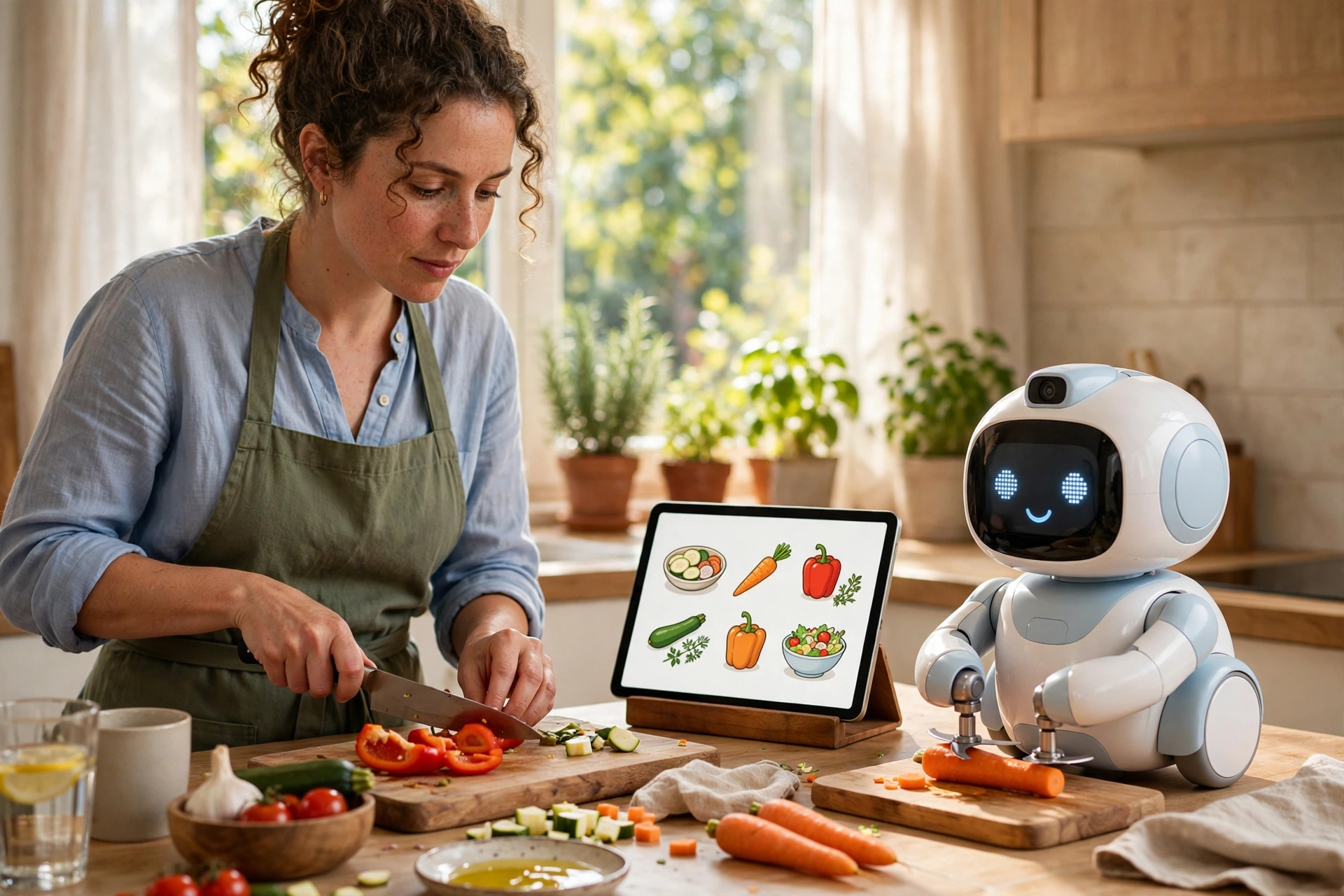
In a restaurant, that can mean repeating the same dish the same way many times a day. At home, it usually means help with one part of cooking, such as stirring, chopping, or keeping a pot at a steady simmer, while you stay in charge of the rest.
Key Takeaways
- Cooking robots turn recipes into timed, repeatable actions using arms, grippers, sensors, and heaters.
- They are strongest at repetitive jobs: stirring, flipping, portioning, and holding a steady temperature.
- They still struggle with soft, slippery, or oddly shaped ingredients, and with judging taste and texture.
- Safety comes from slow speeds, force limits, heat shields, and clear rules about when a person must step in.
- For most homes, a cooking robot is best seen as a helper, not a replacement for a cook.
How does a cooking robot read a recipe?
A recipe for a person is full of judgement calls: “cook until golden”, “season to taste”, or “add a splash of water”. A robot needs firmer instructions. So a cooking robot’s recipe is usually written as a sequence: heat the pan to a set temperature, add a measured amount of oil, stir every thirty seconds, and stop after four minutes. Some systems use a screen or app where you pick a dish and a portion size, and the robot loads that sequence.
More advanced research robots can learn from video or from a person showing them a task, but even then the robot is copying movements and timings, not understanding flavour. That is why the same dish can come out a little different if the ingredients change. A larger onion, a wetter tomato, or a pan that heats unevenly can all shift the result, and a robot may not notice unless it has a sensor that catches the change.
What parts do the cooking for a robot?
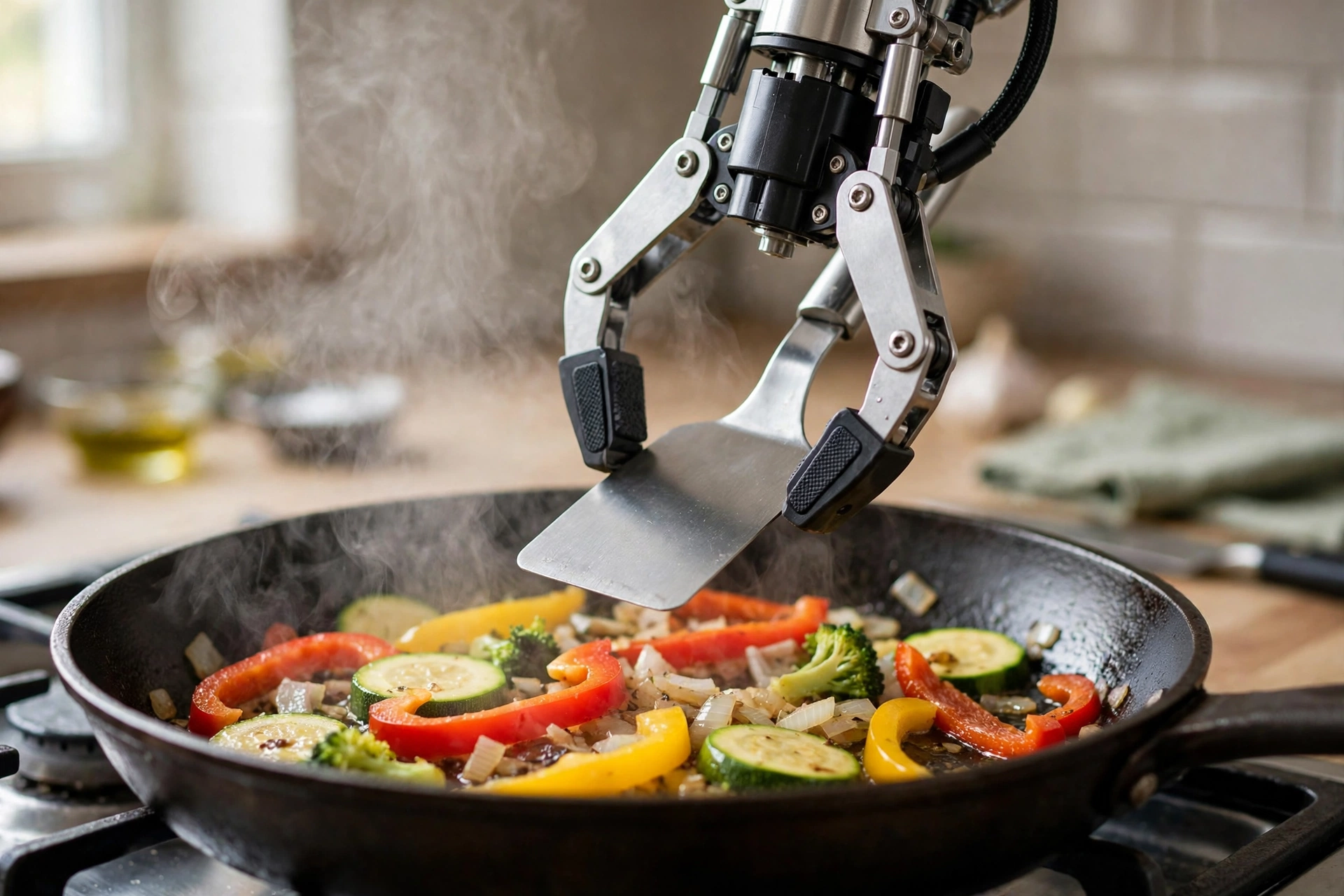
Most cooking robots are built around a robot arm, much like the arms used in factories. If you want the background on those arms, see our guide to how robot arms work. The arm moves a tool — a spatula, a stirrer, a gripper, or a dispenser — to a set position. Joints and motors control how far it reaches and how much force it uses, while encoders track where each joint is at any moment.
Around the arm, you will often find cameras that spot ingredients, weight sensors that check portions, and temperature sensors that watch the pan or oven. A heated bowl or induction plate may be built into the system, so the robot is not just moving food around a normal stove. In a self-contained cooking machine, the pot, the heater, and the stirrer are all part of one unit, which makes timing and temperature easier to control. In a robot that works in a normal kitchen, the arm has to cope with ordinary pots, hobs, and worktops, which is much harder.
How do cooking robots handle heat, knives, and liquids?
Heat is the trickiest part. A robot cannot feel that a pan is too hot, so it relies on sensors and limits. A temperature probe, an infrared sensor, or a timed heating step tells it when to turn the heat down or stop. If a sensor fails or a reading looks wrong, a well-designed system should pause rather than carry on blindly. That pause-and-check habit matters more than speed in a kitchen.
Knives and sharp tools are usually handled in one of two ways. Some systems avoid them altogether, using pre-cut ingredients or a built-in cutter with guards. Others use a blade only in a fixed, enclosed position, so a hand cannot easily reach it while it moves. Liquids need care too: pouring slowly, using a measured dispenser, and keeping the arm’s path away from open flames or hot oil can reduce splashes. None of this makes a kitchen robot risk-free, which is why most designs keep a person nearby and use a clear stop button.
What can cooking robots already do well?
The best jobs for a cooking robot are the ones you would find boring or tiring if you did them all day. Stirring a sauce so it does not catch, flipping items on a grill at the same point each time, and portioning rice or noodles into containers are all repeatable tasks. In a busy restaurant kitchen, that repeatability can help keep quality steady during a rush, and it can take over hot, greasy work that is hard on staff.
You can see a similar idea in drink service, where bartender robots measure, pour, and mix to a set recipe. Cooking robots work on the same principle, just with more heat, more textures, and more steps that depend on timing. At home, smaller helpers already stir, knead, or steam to a programme, even if they do not look like a robot arm. They are less flexible than a person, but they are consistent, and for a weeknight meal that consistency is often the point.
Where do cooking robots still struggle?
Soft food is a good test. A ripe tomato, a piece of fish, or a soft dumpling can squash, tear, or slip if the gripper squeezes too hard or in the wrong place. Robots are getting better at this with softer grippers and force feedback — sensors that tell the arm how hard it is pressing — but a person still adjusts far more quickly by touch. Odd shapes cause trouble too. A robot trained on one size of potato may fumble with a much smaller or knobbly one.
Taste is another limit. A robot can measure temperature, weight, and time, but it cannot tell you that a soup needs a pinch more salt or a squeeze of lemon. Some research systems use chemical sensors to estimate saltiness or sweetness, yet that is still a rough guide, not a cook’s judgement. So for now, most cooking robots follow a tested recipe closely, and a person checks and adjusts the final dish.
Are cooking robots safe to use at home?
Safety depends on the design, not just on the idea. Look for slow, limited movement near people, force limits that stop the arm if it meets resistance, and heat parts that are shielded or clearly marked. A robot that shares a workspace with people — a collaborative style of machine — should slow down or stop when someone gets close. Our guide to collaborative robots explains that shared-work idea in more detail.
Practical habits matter as well. Keep long sleeves, tea towels, and loose hair away from moving parts. Do not reach across a moving arm to grab a pot, and do not override a safety stop because you are in a hurry. Clean sensors and grippers as the maker directs, since a dirty camera or a sticky gripper can cause a mistake. And keep children and pets out of the robot’s working area while it is running, just as you would with a hot hob.
If a cooking robot is built into a closed machine, the risks are different: steam, hot surfaces, and pressure need care when you open it. Follow the maker’s cooling and cleaning steps, and do not open a sealed unit while it is still hot or pressurised. A little patience here prevents most kitchen accidents, robot or not.
How much does a cooking robot cost, and is it worth it?
Prices vary widely, and that range tells you a lot about what you are actually buying. A small countertop cooker with a stirring arm or a programmed pot is far cheaper than a full robot arm that works over your own hob. Restaurant systems cost more again, because they need to run for long shifts, handle larger volumes, and be cleaned to commercial standards.
Whether one is worth it depends on what you cook most. If you make the same stir-fry, soup, or sauce several times a week, a helper that stirs and holds temperature could save real time. If you love trying new recipes, improvising with what is in the fridge, or cooking for guests with different tastes, a robot may feel limiting. Try it, if you can, with a simple dish first, and judge it on the result on your plate, not on how impressive it looks in a video.
What is next for cooking robots?
The next steps are less about speed and more about sensing. Better cameras and touch sensors could help a robot tell when food is cooked through, not just when a timer ends. Smarter recipe software could adjust for portion size or a missing ingredient, rather than stopping at the first change. And safer, softer arms could work closer to people without needing a cage or a wide clear zone.
Even so, cooking will likely stay a shared job for a while: robots handling the repetitive, hot, and heavy parts, and people handling taste, presentation, and the little decisions that make a meal feel personal. That split plays to each side’s strengths, and it is already visible in warehouses and factories, where warehouse robots move and sort while people check, pack, and solve problems.
FAQs
Can a cooking robot cook a full meal on its own?
Some closed systems can, for a limited menu, if the ingredients are loaded correctly. A robot arm in an open kitchen usually still needs a person to prep, load, check, and serve.
Do cooking robots replace chefs?
Not in the full sense. They can repeat a tested recipe, but they do not invent dishes, judge flavour, or adapt as freely as a skilled cook.
Are cooking robots hard to clean?
It depends on the design. Closed machines with removable pots and stirrers are usually easier to clean than an open arm with many joints near food and steam. Check cleaning steps before you buy.
Can a cooking robot handle allergies or special diets?
Only if the recipe and ingredients are set up for that diet, and the machine is cleaned to avoid cross-contact. A robot does not know about an allergy unless you tell it, so double-check ingredients and cleaning yourself.
What should I check before buying a cooking robot?
Check the menu or recipe range, the portion sizes, cleaning steps, safety stops, and what happens if a sensor or step fails. A clear pause-and-check behaviour is a good sign.
Conclusion
Cooking robots work by turning a recipe into careful, timed movements, with sensors watching temperature, position, and force along the way. They shine at repetitive tasks and steady heat, and they still need a person for taste, tricky ingredients, and safety checks. If that sounds useful for your kitchen, start small: pick one dish you make often, try a helper that handles its most repetitive step, and keep yourself in charge of the final taste. That way you get the convenience without handing over the cooking you actually enjoy.
Further reading: Britannica: Robotics and IEEE Spectrum: Cooking robots